


Page 226 - NAVAL SCIENCE 3 TEXTBOOK
P. 226
232      NAVAL  SKILLS


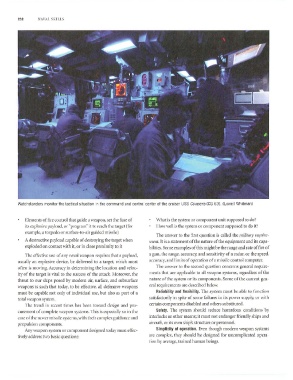
        Watchstanders monitor the tactical  situation  in the command  and control  center of the cruiser  USS  Cowpens (CG  63).  (Lowell Whitman)


            Elements of fire control that guide a weapon, set the fuse of   \Vhat is the system or component unit supposed to do?
            its explosive payload, or "program" it to reach the target (for   How well  is the system or component supposed to do it?
           example, i1  torpedo or surface-to-air guided missile)
                                                                  The answer  to  the first question is called  the military reqllire-
            A destructive payload capable of destroying the target when   II/Cllt . It is a statement of the nature of the equipment and its capa-
           exploded all contact with it, or in dose proximity to it   bilities. Some examples of this might be the range and rate of fire of
           The effective use of any naval weapon requires that a payload,   a gUll, the range, accuracy, and sensitivity of a radar, or the speed,
         usually an  explosive device,  be delivered  to  a  target, which  most   aCClll'ilC)', and limits of operation of a missile control computer.
                                                                  The answer to  the second question concerns general require-
        often  is  moving. Accuracy ill determining the location and veloc-
                                                               ments that are applicable to <111  weapon systems, regardless of the
         ity of the target is  vital  to  the success of the attack. Moreover, the
         threat  to  our ships posed  by  modern air,  surl~lCe, and subsurface   nature of the systern or its components. Some of the current gen-
        weapons is  sllch  that  today,  to  be effective, all  defensive  weapons   eral requirements are described below.
                                                                  Reliability  and  flexibility.  The system must  be able to  function
         must be capable  not only of individual  usc,  but also  itS  part of it
         total weapon system.                                  satisfactorily in  spite of some failures  in  its power supply, or with
           The trend  in  recent  times  has  been  toward  design  and  pro-  certain components disabled and others substituted.
        curement of complete weapon systems. This is  especially so in  the   Safety.  The  system  should  reduce  hazardous  conditions  by
        case of the newer missile systems, with their complex guidance and   interlocks 01' other means; it must not endanger friendly ships and
                                                               aircraft, or its own ship's structure or personnel.
        propulsion components.
                                                                  Simillicity  of  operation.  Even  though  modern weapon systems
            Any weapon system or component designed today must effec-
                                                               are  complex,  they  should  be  designed  for  uncomplicated opera-
        tively address two basic questions:
                                                               tion by average, trained human beings.

