


Page 231 - NAVAL SCIENCE 3 TEXTBOOK
P. 231
NAVAL  WEAPONS AND AIRCRAFT      237


         the  system  will  automatically  ce<1se  firing  and  begin  searching   rotating  band   body   ogive
         for  another  target.  1\  follow-on  CI\'VS  system  to  Phalanx  called
         the  Sea-ltlIl1  L1ses  a  magazine  of eleven  rolling airti·ame  missiles
         (RAM) vice a Gatling gun to engage close-in t<1rgets.  It is  installed
         in littoral comb<1t ships.
            Types of guns on tod<1Y's naval aircraft will be discussed in  the
         following chapter.                                           base           bourrelet
                                                                              bUrster  charge  bourreiel   nose  fuze
         Gun Ammunition
         The  principal  components  of a  full  round  of gun  amlllunition
         arc a propellillg chillge (propellant) and a projectile. The propelling
         charge provides the thrust th<1t ejects  the projectile at  the desired
         velocity from the muzzle of the gun. The propelling charge asselll-  rotating  band   projeclile body
         bly includes an ignition system, the propellant, and the container.
                                                                          thick walls   nose  cap   windshield
         The payload  or projectile assembly  includes  the detonating fuse,
         the booster, and the burster charge.
            In a naval gun, the propellant charge is packed behind the pro-
         jectile, either in bags or in  metal cartridge cases.  If the propellant
         is packed  in  bags, the amlllunition is  called  bag allll/lllI/itio/l; if it
                                                                      base     cavity  for burster   cavity
         is packed in a case, it  is called case allll/llllli601l. The huge 16-inch
                                                                      detonaling  fuze
         gUllS of the old  retired  battleships used bag ammunition, but all
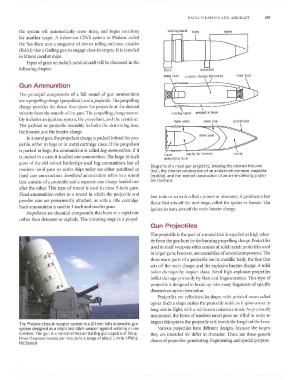
                                                                Diagrams of a naval  gun  projectile, showing the external  features
         modern  naval  guns on active ships today use either semifixed or
                                                                (top),  the  internal  construction of an  antiaircraft common  projectile
         fixed  case alllmunition. SClllifixed amlllunition  refers  to a  round   (middle), and  the  internal construction of an  armor-piercing projec-
                                                                tile  (bottom).
         that consists of a projectile and a separate case charge loaded one
         after  the  other.  This type  of round  is  lIsed  in  most 5-inch gUllS.
         Fixed  ammunition  refers  to a  round  in  which  the projectile and
                                                                lant train or series is called a prilller or dctOllfltor; it produces a hot
         powder  case  are  permanently attached.  as  with  a  rifle  cartridge.
                                                                flame that sets olf the next stage, called the iglliter or booster. The
         Such ammunition is used in 3-inch and smaller guns.
                                                                igniter, in turn, sets off the main burster charge.
            Propellfllits are chemical compounds that burn at a rapid rate
         rather than detonate or explode. The initiating stage in a propel-
                                                                Gun Projectiles
                                                                The projectile is  the part of a round that is expelled at high vcloc-
                                                                ity from the gun bore by the burning propelling charge. Projectiles
                                                                used in slllall weapons often consist of solid metal; projectiles lIsed
                                                                in larger gUllS, however, are assemblies of several components. The
                                                                three main parts of a projectile are its  metallic body, the fuse  that
                                                                sets off the main charge. and the explosive burster charge. A solid
                                                                bullet damages  by  impact aione.  Naval  high-explosive  projectiles
                                                                inflict damage primarily by blast and fragmentation. This type of
                                                                projectile is designed to break Up  into many fragments of specific
                                                                dimensions upon detonation.
                                                                   Projectiles are cylindrical  ill  shape, with  pointed noses  called
                                                                ogil'cs. Such a shape makes the projectile stable as it spins about its
                                                                long axis in  flight, with a minimum resistance to air. As previously
                                                                mentioned, the bores of modern naval guns arc rifled in  order to
                                                                impart this spin to the projectile as it travels the length of the bore.
         The  Phalanx close-in weapon  system  is a 20-mm fully automatic gun
         system  designed as  a ship's last-ditch weapon against antiship cruise   Various  projectiles  have  different  designs, because  the  targets
         missiles.  The gun  is a six-barrel  Vulcan Gatling gun capable of firing   the),  are  intended  for  difter  in  character.  There  are  three  generai
         three thousand  rounds per  minute to a range of about  1 mile.  (Philip   classes of projectiles: penetrating, fragmenting, and special purpose.
         McDaniel)

