


Page 255 - NAVAL SCIENCE 3 TEXTBOOK
P. 255
NAVA L WEAPONS  AND A IRCRAFT   261

         nd and civilians in danger of being exposed to this kind of attack.   explosion, and  heavy  residual radiation from  the  highly contam·
         Sev(.'n.11 kinds of nntibiotics ;He effective  in  treating the effects of   illatcd  base surge.  This  is the wall  of heavy  mist  at  sea, or cloud
         Illany kinds of U\ V ngents ilfter e:...vosure.        of dust on land, created around ground zero when the column of
                                                                w<lter or dirt formed by the explosion ralls back to the Stlrf..1ce.
                                                                   In  the case of mdionctive material dispersed by il  conventional
         Nuclear Warfare
                                                                explosive, there will be some shock and heat dnmnge in close prox·
         Nuclear wnrfilre involves the use of weapons or devices armed with   imity ns with all such detonations, but the most troublesome efiect
         nuclear  wilrheilds, or  improvised "dirty  bombs" with  radioactive   is  the  radionctive  material  that  can  be  sprend  ror  some  distance.
         materials dispersed by cOllventional explosives.       Anyolle or anything nei.lr the site of sllch nil attack call be contami-
            \Vhen a nuclear warhead detonates, alrcmendolls shock wave   nated with  this material. The site itself mi.ly be  ullusable for  a long
         is released, along with intense pulses of light, heat, and electromag·   time until complete decontnlllinatioll cnn be accomplished, if ever.
         netic and nuclear radiation. These efiects, though dev<lstating, I<lst   The  effect  of nuclear  radintioll  on  people  depends  on  the
         only a few  seconds.  Subsequent rildioilctive fallout  from  this kind   intensity of the radiation and the time of exposure. The amount of
         of attnck c<ln continue for d<l)'s, <lnd spread o\'er I<lrge areas if car-  radiation received is called the dosage, and is measured by devices
         ried by wind or water clirrents.                       such  ns  film  badges  called  dosimeters.  The  effects  of radiation
            The shock  W<lve,  or blast,  from  a nuclear detonation, just <IS   exposure are most severe on soft tissues in the body. They can vary
         with  any explosion, Can  smash  ships. level  buildings,  nnd  cause   from  short-term illness  and  nausea,  to  hair loss,  imlllune system
         casuailics for miles. The light pulse call blind anyone within miles.   deficiencies, sterility, long-term  genetic  defects, skin  lesions.  leu-
         The  thermonuclear heat.  called  thermill  radiation,  is  so  intense   kemia nnd other cnncers, mentnl impairment, and severe sickness,
         that  al1Y  metal  neill" ground zero  (the site of the explosion)  ma)'   delirium, and denth within dnys or weeks, depending all the dos-
         melt, nnd tl<llmnable objects will burst into flame. Soft bod}' tissue   nge recei\Ted and the time interval over which it occurs. i\·loreover,
         of anyone nenrby witl vnporize, and serious burns 10 exposed skin   the efiects of radiation dosage are Cllllllflntil'c, meaning that even
         can occur out to ns far as 25 miles away. The electron1<lgnetic pulse
         (EMP) can fry electronics for miles around.
            The illitia/ll//c1ear radiation, or first  radiation. e<llmot be seen
         or felt, but it 'all be as deadl)' as all)' of the other efTects. This radi-
         atioll is made up of alpha (like a heliulll  Ilucleus) and beta  (high-
         energy electron) pnrlicles, high-speed neutrons, and gamma ra),s.
         All  these  pnrticles and rays are lethal  to  human  tisslle. Alphn  pnr-
         ticles  can  be  stopped  b)' a sheet  of paper;  beta  particles can  be
         stopped by a thin sheet of aluminum. The others are much more
         difficult  to  stop  with  an)'thing less  than  heavy  lead  shielding  or
         somc other dcnse substance.
            Residual  radiatioll,  or fallollt,  consists  of radioactive  materi·
         als produced by the explosion, plus dust contaminated with nlph<l
         and beta particles. It l11a), be deposited lor da)'s over a large area by
         wind  nnd ",enther. This fallout  (;111  be detected  and  mensureci  by
         special  instruments called  radiacs  (Geiger counters).  If it  is pres·
         ent in hazardous cOllcentrations, the area must be decontnlllinated
         (washed clean) before unprotected personnel C<lll enter the area.
            Ships I1ln)' be exposed  to  three types of nuclear bursts:  an  nir             (
                                                                                           ~  ,
         burst,  in  which  the fireball  does  not  touch  the  Earth;  it  surface
                                                                                             ,  I
         burst,  in  which  the fireball  tOllches  the surface;  and  il subsurfnce
         burst,  ill  which  the explosion  is  underwater.  An  nir  burst  pro·
         duces blnst, he<lt, intense light, and initial radintion, but little fall-
         out requiring decontamination. A surface  burst will  produce  the
         S<l111e effects, plus much residual radiation. The fnHoul will spread
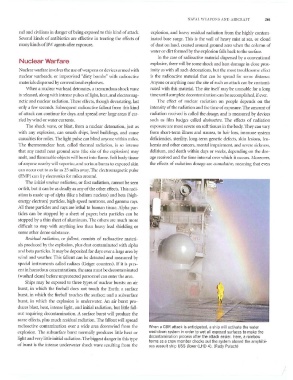
         radioactivc contaminiltion  o\'er a wide area  downwind  from  the   When a CBR attack is antiCipated, a ship will activate the water
         explosion.  The subsurfnce  burst  normally produces  little  heat  or   washdown system  in order to wet all  exposed surfaces to make the
                                                               decontamination process after the attack easier.  Here,  a rainbow
         light and very little initial radiation. The biggest danger in this type
                                                               forms as a crew member checks out the system  aboard  the amphibi-
        of burst is  the intense underwater shock wnve  resulting from  the   ous assault ship USS  Boxer (LHD 4). (Rudy  Pulach)

