


Page 59 - NAVAL SCIENCE 3 TEXTBOOK
P. 59
64      NAVA L  KN OWLED G E

         unit 1) that apply to  all  types of combat, there are certain princi-
         ples of logistics  that come into play in logistics planning at all  lev-
         els. These are

            Responsiveness-providing the right support at the right
            time, at the right place
            Sinlplicity-avoiding unnecessary complexity in preparing,
            planning, and conducting logistic operations
            Flexibility-adapting logistic support to changing conditions
            Economy--employing logistic support assets effectively
            Attainability-acquiring the minimum essential logistics sup-
            port to begin combat operations
            Sustainability-providing logistics support for the duration of
            the operation
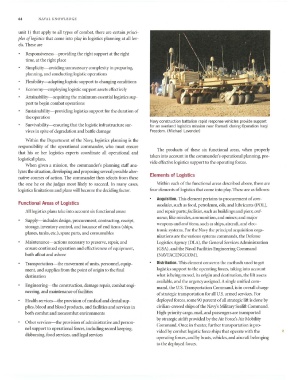
                                                                Navy construction battalion rapid  response vehicles provide support
            Survivability--ensuring that the logistic infrastructure sur-  for an  overland  logistics mission near Ramadi  during Operation  Iraqi
            vives in spite of degradation and battle damage     Freedom.  (Michael  Lavender)
            Within the  Department of the Navy,  logistics planning is  the
         responsibility  of the  operational  commander, who  must  ensure
                                                                   The  products  of these  SL,{  functional  areas,  when  properly
         that  his  or  her  logistics  experts  coordinate  aLI  operational  and
                                                                taken into account in the commander's operational planning, pro-
         logistical plans.
                                                                vide effective logistics support to the operating forces.
            When given  a mission,  the commander's planning staff ana-
         lyzes the situation, developing and proposing several possible alter-
                                                                Elements of  Logistics
         native courses of action. The commander then selects fi·om these
         the  one he or she judges  most  likely  to  succeed. In many cases,   Within each of the functional areas described above, there are
         logistics limitations and plans will become the deciding factor.   four elements of logistics that come into play. These are as follows:

                                                                   Acquisition. This element pertains to procurement of com-
         Functional Areas of Logistics
                                                                   modities, such as food, petroleum, oils, and lubricants (POL),
            All logistics plans take into account six functional areas:   and repair parts;facilities, such as buildings and piers; ord-
                                                                   nance, like missiles, ammunition, and mines; and major
            Supply-includes design, procurement, contracting, receipt,
                                                                   weapons and end itell1s, such as ships, aircraft, and elec-
            storage, inventory control, and issuance of end items (ships,
                                                                   tronic systems. For the Navy the principal acquisition orga-
            planes, tanks, etc.), spare parts, and consumables
                                                                   nizations are the various systems commands, the Defense
            Maintenance-actions necessary to preserve, repair, and   Logistics Agency (DLA), the General Services Administration
            ensure continued operation and effectiveness of equipment,   (GSA), and the Naval Facilities Engineering Command
            both afloat and ashore                                 (NAYFACENGCOM).
            Transportation-the movement of units, personnel, equip-  Distribution. This element concerns the methods used to get
            ment, and supplies fi·om  the point of origin to the final   logistics support to the operating forces, taking into account
            destination                                            what is being moved, its origin and destination, the Lift assets
                                                                   available, and the urgency assigned. A single unified com-
            Engineering-the construction, damage repair, combat engi-
                                                                   mand, the U.S. Transportation Command, is in overall charge
            neering, and maintenance of facilities
                                                                   of strategic transportation for all U.S. armed services. For
            Health services-the provision of medical and dental sup-  deployed forces, some 90 percent of all strategic lift is done by
            plies, blood and blood products, and facilities and services in   civilian-crewed ships of the Navy's Military Sealift Command.
            both combat and noncombat environments                 High-priority cargo, mail, and passengers are transported
                                                                   by strategic airlift provided by the Air Force's Air Mobility
            Other services-the provision of administrative and person-
                                                                   Command. Once in theater, further transportation is pro-
            nel support to operational forces, including record keeping,                                               ,
                                                                   vided by combat logistic force ships that operate with the
            disbursing, food services, and legal services
                                                                   operating forces, and by boats, vehicles, and aircraft belonging
                                                                   to the deployed forces.

