


Page 62 - NAVAL SCIENCE 3 TEXTBOOK
P. 62
II Naval Research and Development


         The scientific and military strength of the United States depends
         to a large eA1:ent on a successful and comprehensive research pro-
         gram.  Research  and  development  (R&D)  in  the  Department of
         Defense and its military branches is a major effort in terms of per-
         sonnel, money, and materials.
            All  military services  conduct various R&D  programs in  their
         areas  of responsibility.  In  recent  years,  increasing  numbers  of
         these  programs  have  been  conducted jointly by  the  services,  as,
         for  example, the development of the next-generation joint strike
         fighter.  The U.S.  Coast Guard is  also  an active  participant in  the
         research and development program.


         Navy R&D Management
         Under the secretary of defense, the secretary of the Navy has pol-
         icy control over the Navy R&D organization. Ultimate responsibil-
         ity rests  with  that person. The assistant secretary of the Navy for
         research, development, and acquisition is responsible for manage-
         ment and control of R&D  matters. The top adviser to  these two
         civilian  leaders  is  the  chief of naval  research.  The  chief of naval
         research  is  in  charge of the  basic  research  program  of the  Navy,
         coordinating all Navy efforts with the systems commands.
            The agencies  that ultimately develop  and procure the equip-
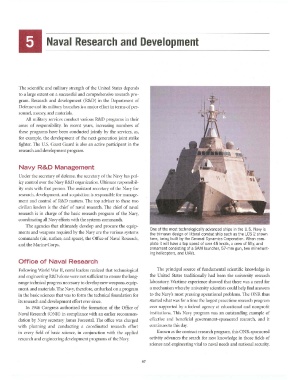
                                                                One of the most technologically advanced  ships in  the U.S.  Navy is
         ments and weapons required by the Navy are the various systems
                                                                the trimaran  design  of  littoral combat ship such  as the LCS  2 shown
         commands (air, surface, and space), the Office of Naval Research,   here,  being built by the General  Dynamics Corporation.  When  com-
         and the l\llarine Corps.                               plete  it wi II  have a top speed  of over 45 knots,  a crew of fifty,  and
                                                                armament consisting of a SAM  launcher,  57-mm gun,  two minehunt-
                                                                ing helicopters, and  UAVs.
         Office of Naval Research
         Follovving "'''orld Vlar  II,  naval  leaders  realized that technological   The principal source of fundamental  scientific knowledge  in
         and engineering R&D alone were not sufficient to ensure the long-  the  United  States  traditionally  had  been  the  university  research
         range technical progress necessary to develop new weapons, equip-  laboratory. vVartime experience showed that there was a need for
         ment, and materials. The Navy, therefore, embarked on a program   a mechanism whereby university scientists could help find answers
         in the basic sciences that was to form the technical foundation for   to the Navy's most pressing operational problems. The ONR thus
         its research and development effort ever since.        started what was for a time the largest peacetime research program
            In  1946  Congress  authorized  the  formation  of the  Office  of   ever supported by a  federal  agency at educational  and  nonprofit
         Naval  Research  (ONR)  in  compliance with an earlier recommen-  institutions.  This  Navy program was  an  out~tanding example of
         dation by Navy secretary James Forrestal. The office was  charged   effective  and  beneficial  government-sponsored  research,  and  it
         with  planning  and  conducting  a  coordinated  research  effort   continues to this day.
         in  every  field  of basic  science,  in  conjunction  with  the  applied   Known as the contract research program, this ONR-sponsored
         research and engineering development programs of the Navy.   activity advances  the search for new knowledge in those fields  of
                                                               science and engineering vital to naval needs and national security.


                                                            67

