


Page 83 - NAVAL SCIENCE 3 TEXTBOOK
P. 83
88      NAVAL  KNOWLEDGE

         Military and Naval Attaches
         According  to  international  law,  military and  naval  attaches  are
         regarded  as  high-ranking  members  of the  ambassador's  official
         staff.  They  cnjoy  the  same  diplomatic  immunities  and  protec-
         tion  as  the ambnssador.  These  include  freedom  to  cOlllmunicate
         with  the home government; safety and security of self, staff, and
         family; inviolability  of home and  embassy;  and  certain  jurisdic-
         tional  imlllunities  such as  freedom  from  criminal  and  civil  laws.
         However, the ambassador and  each  person on  the stair mllst nct
         in a manner befitting their rank and  position, conforming to high
         standards or behavior.  If a diplomat repeatedl),  breaks locallall's,
         the  host  government may declare  him  or  her perso/w  /101/  gmtfl
         (not ncceptable) and demand his or her removnl.
            Nnvnl and  military attaches  of the  United  States  are  selected
         by  their services and  assigned  by the  Department of Defense  to
         American  legations  or  embassies  overseas.  The senior  attache,
         regardless of service. is  called the defense i.1tIi.1Chc.  and  others arc
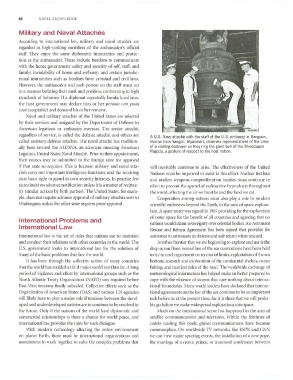
                                                                A U.S.  Navy attache with the staff of the U.S. embassy in Rangoon,
         Ci.llled  assistant defense attaches. The naval  nttache has  tradition-  BUrma (now Yangon,  Myanmar), observes representatives of the crew
         <Illy been termed the AI.USNA,  an acronym  meaning American   of a visiting destroyer as they ring the giant bell of the Shwedagon
                                                                Pagoda, a gesture of respect to the host  nation,
         Legation, United States Nm'i.ll Attache. Prior to their appointment.
         their  names  may be submitted  to  the  foreign  state for  approval
         if that state so  requires. This is  because  military  and  naval atta-  will  inevitably continue to  arise.  The effectivcness of the  United
         ches carry out important intelligence fUIlctioIls, and the receiving   Nations must be improved to assist in  this effort. Nuclear test ban
         state has a right to guard its own security interests. In  practice fcw   and  nuclear weapons  nonproliferation  treaties  must continue  in
         states insist on advance notification unless it is a matter of reciproc-  effect to prevent the spread of radioactive byproducls throughout
         ity (similar actions by both  parties). The United States, for exam-  the world, aftecting the air we brcOlthc and the food we eat.
         ple, does not require advance approval of military attaches sent to   Cooperation among nations must  also  playa  role  in  modern
         \Vashingtonunlcss the other state requires prior approval.   scientific endeavors beyond the Enrth, in  the area of space eXpIOf<l-
                                                                tioIl. A space treaty Wi.1S signed in 1967 providing lor the exploratioIl
                                                                of outer space  lor the benefit of all  countries and agreeing that no
         International Problems and
                                                                nations would claim sovereignty over celestial bodies. An Astronaut
         International Law
                                                                Rescue and  Rehlfll  Agreement has been signed thOlt provides tor
         Intern;Jtional  law  is the set of rules  that  nations usc  to maintain   assistance to astronnuts in distress and safe return \\'hen rescued.
         and conduct their rel;Jtions with other cOlilltries ill the world, The   Another frontier that we tlre beginning to explore and use is the
         U.s.  government  looks  to  international law  for  the solution  of   deep ocean floor. SeYerallaw of the sea conventions have been held
         many of the basic problems that face the world.        to try to reach agreement on territorial limits, exploitation of the sea
            It  has been through the collective  action  of many  countries   bottom, research and exploration of the continental shelves, ocean
         that the world has avoided a third major world war thus far. A long   fishing, and I1alltic.lI  rules of the road. The worldwide exchange of
         period of vigilance and efiort by  international groups such as the   meteorological information has helped make us better prepared to
         North  Atlantic 'Ih:aty Organization  (NATO) was  required  before   cope with  the violence of storms that cnre nothing nboLlt  interna-
         East-\Vest  tensions finally subsided. Collective enOrlS slIch  as the   tional boundaries. ~'lnn)' world  leaders  have declared that interna-
         Organization of American Stntes  (OAS) and variolls UN agencies   tional agreements on the la\\' of the sea contillue to be an important
         will  likely have to piny n Illnjor role  if tensions behvcell  the devel-  tnsk before us at the present time. tor it is there that we will probiJ-
         oped nJld underdeveloped nntions are to continue to be resolved ill   bl)' go bdore we make widespread explorations into space.
         the future.  Only if the nntians of the  world have  diplomatic and   lvluch on  the international scene has  happened in  the area of
         commercial relationships is there a chance for  world  peace, and   sateUite  communications and  television.  \Vithin  the  lifetimes of
         international law provides the rules for such dialogue.   cadets  rending  this  book, global  communications have become
            \Vith  modern  technolog}'  alTecting  the  entire  environment   commonplace. On worldwide TV neh\'orks like ESPN and CNN
         on  planet  Earth,  there  mllst be  international  organizations and   we can view major sporting events, the installation of a new pope,
         associntions to work together to solve the complex problems that   the marriage of a crown prince, or a sllmmit conference between

