


Page 150 - NS-2 Textbook
P. 150
THE  COLD WAR ERA                                                                                     143

       Much  of  this  state  of  affairs  resulted  from  restrictive   democracy that, once set in motion, rapidly engulfed the
       Commmustic policies  concerrling private  property and   Soviet Union. The populations of the satellite states took
       the accmnulation of personal wealth and an emphasis on   advantage of the erosion of Soviet control  to press for-
       military  spending.  These,  in  conjunction  with years  of   "vard  successful  self-determination  movements.  111ese
       cold war military poshrring and provocative foreign pol-  eventually  resulted  in  complete  independence  of  all
       icy had severely limited any infusion of money and tech-  the  former  satellite  states  by  1990.  Perhaps  the  most
       nology from the West.                                   important and surely the most emotional symbol of the
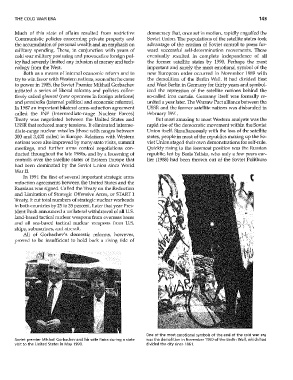
           Both as a means of internal economic reform and to   new European order occurred in November 1989 with
       try to win favor with Western nations, soon after he came   the  demolition  of  the  Berlin Wall.  It had  divided East
       to power in 1985, the Soviet Premier Mikhail Gorbachev   and West Berlin in Germany for tlUrty years and symbol-
       initiated a  series  of liberal  reforms  and policies  collec-  ized  the  repression  of  the  satellite  nations  behind  the
       tively called glasnost (new openness in foreign relations)   so-called iron curtain.  Germany itself was formally re-
       and perestroika  (internal political and economic reforms).   united a year later. The Warsaw Pact alliance between the
       In 1987 an important bilateral arms-reduction agreement   USSR and the former satellite nations was disbanded ill
       called  the  INF  (Intermediate-range  Nuclear  Forces)   February 1991.
       Treaty  was  negotiated  between  the  United  States  and   But most amazing to most Western analysts was the
       USSR that reduced many tensions. It eliminated interme-  rapid rise of the democratic movement within the Soviet
       diate-range nuclear missiles (those with ranges between   Union itself. Simultaneously with the loss of the satellite
       300 and 3,400 miles) in Europe. Relations with Western   states, people in most of the republics making up the So-
       nations were also inlproved by many state visits, summit   viet Union staged their own demonstrations for self-rule.
       meetings,  and  further  arms  control  negotiations  con-  Quickly rising to the foremost position was the Russian
       ducted throughout the late 1980s, and by a looserling of   republic, led by Boris Yeltsin, who only a few years ear-
       controls  over the satellite states  of Eastern Europe that   lier (1988)  had been thrown out of the Soviet Politburo
       had been  dominated by the Soviet Union since World
       War II.
           In 1991  the first of several important strategic arms
       reduction agreements between the United States and the
       Russians was signed. Called the Treaty on the Reduction
       and Limitation of Strategic Offensive Arms, or START 1
       Treaty, it cut total nmnbers of strategic nuclear warheads
       in both countries by 25 to 35 percent. Later that year Pres-
       ident Bush announced a unilateral withdrawal of all u.s.
       land-based tactical nuclear weapons from overseas bases
       and  all  sea-based  tactical  nuclear  weapons  from  U.S.
       ships, sublnarines j  and aircraft.
           All  of  Gorbachev's  domestic  reforms,  however,
       proved  to  be  insufficient  to hold back  a  rising  tide  of


                                                              One  of the most emotional symbols of the end of the cold  war era
       Soviet premier Mikhail Gorbachev and his wife Raisa  during a state   was the demolition in November 1989 of the Berlin Wall, which had
       visit to the United States in  May 1990.               divided the city since  1961.

