


Page 149 - NS-2 Textbook
P. 149
142                                                                                      MARITIME HISTORY


                                                                tions transiting the gulf, especially the Strait of Hormuz,
                                                                were subject to air and mine attacks by both nations. Be-
                                                                cause  of  our  political posture in  the  area-the United
                                                                States has generally assumed the role  of peacemaker-
                                                                and perhaps also because we are somewhat less depen-
                                                                dent on Middle Eastern oil than most other Western na-
                                                                tions  and  therefore  less  vlih1erable,  the  United  States
                                                                played a major role in keeping the Persian Gulf open for
                                                                transit  by  oil  tankers  of  all  nations  during  the  latter
                                                                stages of the Iran-Iraq War.  Throughout 1987 and 1988
                                                                U.S.  frigates  and  cruisers  served  as  convoy escorts, ac-
                                                                companying and protecting tankers transiting the gulf.
                                                                    These operations were not conducted without cost.
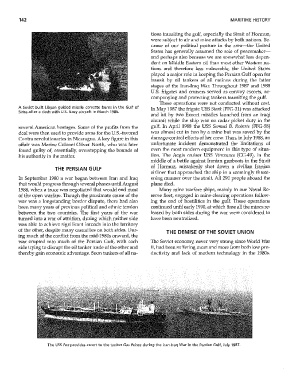
         A Soviet-built  Libyan  guided  missile  corvette  burns  in  the  Gulf  of   In May 1987 the frigate USS Stark (FFG-31) was attacked
         Sidra after a clash with  U.S.  Navy aircraft in  March  1986.
                                                                and hit by two Exocet missiles launched from  an Iraqi
                                                                aircraft while the ship was on radar picket duty in the
         several American hostages. Some of the profits from the   gulf.  In  April 1988  the USS  Samllel  B.  Roberts  (FFG-58)
         deal were then used to provide arms for the U.S.-favored   was alnlost cut in nvo by a mine but was saved by the
         Contra revolutionaries in Nicaragua. A key figure in this   damage-control efforts of her crew. Then, in July 1988, an
         affair was Marine Colonel Oliver North, who was later   lmfortunate  incident  demonstrated  the  limitations  of
         found guilty of,  essentially, overstepping the bounds of   even the most modern equipment in this type of situa-
         his authority in the matter.                           tion.  The  Aegis  cruiser  USS  VillceIllles  (CG-49),  in  the
                                                                middle of a battle against Iranian gunboats in the Strait
                                                                of  Hormuz,  mistakenly  shot  down  a  civilian  Iranian
                        THE  PERSIAN  GULF
                                                                airliner that approached the ship in a seemingly threat-
         In September 1980 a  war began between Iran and Iraq   ening marmer over the strait. All 290 people aboard the
         that would progress through several phases until August   plane died.
         1988, when a truce was negotiated that would end most      Many mine warfare ships, mainly in our Naval Re-
         of the open warfare. Though the proximate cause of the   serve fleet, engaged in mine-clearing operations follm-\T-
         war was a longstanding border dispute, there had also   ing the  end of hostilities  in  the  gulf.  These  operations
         been many years of previous political and ethnic tension   continued until early 1990, at which time all the mines re-
         between the  two  COlmtries.  The  first  years  of  the  ·war   leased by both sides during the war were considered to
         turned into a war of attrition, during which neither side   have been neutralized.
         was able to achieve significant inroads into the territory
         of the other, despite many casualties on both sides. Dur-     THE  DEMISE  OF THE  SOVIET UNION
         ing much of the conflict from the mid-1980s onward, the
         war erupted into  much of  the Persian Gulf, with each   The Soviet economy, never very strong since World War
         side trying to disrupt the oil tanker trade of the other and   II, had been suffering more and more from both low pro-
         thereby gain economic advantage. Soon tankers of all na-  ductivity  and  lack of modern technology  in the 1980s.


                     The  USS Fox provides escort to the tanker Gas Prince during the Iran-Iraq War in the Persian  Gulf, July 1987.

