


Page 156 - NS-2 Textbook
P. 156
THE  19905 AND BEYOND                                                                                 149


                                                              ned. Economic sanctions against Serbia and Montenegro
                                                              were inlposed the following May,  also with little effect.
                                                              By the end of 1992 the sihlation had deteriorated to the
                                                              point that Yugoslavia ceased to exist for a tinle as a sepa-
                                                              rate nation.
                                                                  In October  1992  the  UN established  a  no-fly zone
                                                              prohibiting flights  of military aircraft  over  Bosnian air
                                                              space, which was extended to cover all types of aircraft
                                                              in  early  1993.  The  UN  also  proclaimed  so-called  safe
                                                              areas around several cities, including the nearly leveled
                                                              city of Sarajevo in southeastern Bosnia, control of which
                                                              had been a strategic objective of both sides in the conflict.
                                                              Air Force planes and Navy ships and carrier- and land-
                                                              based aircraft helped NATO forces enforce the embargo,
                                                              no-fly zones, and safe areas, but President Clinton was
                                                              reluctant to introduce grOtmd troops into the conflict. In-
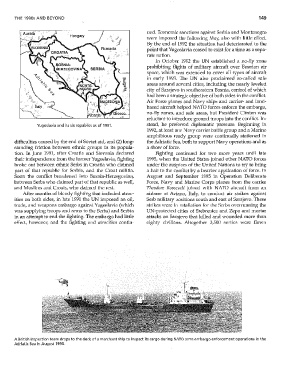
                 Yugoslavia and its six republics as of 1991.   stead,  he  preferred  diplomatic  pressure.  Beguming  in
                                                              1992, at least one Navy carrier battle group and a Marine
                                                              amphibious  ready group were continually stationed in
       difficulties caused by the end of Soviet aid, and (2) long-  the Adriatic Sea, both to support Navy operations and as
       standing  friction  between etlmic  groups in its  popula-  a show of force.
       tion.  In June  1991,  after Croatia and Slovenia  declared   Fighting  continued  for  two  more  years  until  late
       their independence from the former Yugoslavia, fighting   1995, when the United States joined other NATO forces
       broke out between ethnic Serbs in Croatia who claimed   under the auspices of ilie United Nations to try to bring
       part of that republic  for  Serbia,  and  the  Croat  militia.   a halt to the conflict by a heavier application of force. In
       Soon  the  conflict  broadened  into  Bosnia-Herzegovina,   August  and  September  1995  in  Operation  Deliberate
       between Serbs who claimed part of that republic as well,   Force, Navy and Marine Corps planes from  the carrier
       and Muslims and Croats, who claimed the rest.          Theodore  Roosevelt  joined with NATO  aircraft  from  an
           After months of bloody fighting that included atroc-  airbase  at Aviano,  Italy,  to  conduct  air  strikes  against
       ities on both sides, in late 1991  the UN imposed an oil,   Serb military positions south and east of Sarajevo. These
       trade, and weapons embargo against Yugoslavia (which   strikes ,vere in retaliation for  the Serbs overrunning the
       was supplying troops and arms to the Serbs) and Serbia   UN-protected cities of Srebrenica and Zepa and mortar
       in an attempt to end the fighting. The embargo had little   attacks on Sarajevo iliat killed and wounded more than
       effect,  howevel;  and  the  fighting  and atrocities  contin-  eighty  civilians.  Altogether  3,500  sorties  were  flown


       A British inspection team drops to the deck of a merchant ship to inspect its cargo during NATO arms embargo enforcement operations in the
       Adriatic Sea  in August 1993.

