


Page 267 - NS-2 Textbook
P. 267
262                                                                                     NAUTICAL SCIENCES


                                                                     SUN-----~--__
                                                      UP

                                          ~14=----SUN


                                                        AT  SAME  LATITUDE,
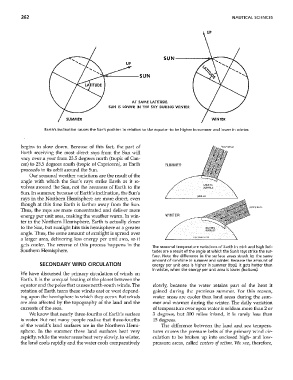
                                              SUN  IS  LOWER  IN  THE  SKY  DURING  WINTER


                    Earth's inclination causes the Sun's position in  relation to the equator to be higher in summer and lower in  winter.


          begins  to  slow  down.  Because  of  this  fact,  the part of
          Earth  receiving the most direct  rays  from  the Sun will
          vary over a year from 23.5 degrees north (tropic of Can-
          cer) to 23.5 degrees south (tropic of Capricorn), as Earth   SUMMER
          proceeds in its orbit around the Sun.
             Our seasonal weather variations are the result of the
          angle  with which  the  SW1'S  rays  strike  Earth  as  it  re-
                                                                                      £ARTHS
          volves around the Sun, not the nearness of Earth to the                     SURFACE
          Sun. In sununer, because of Earth's inclination, the Sun's
          rays in the Northern Hemisphere are more direct, even
          though at this time Earth is farther away from the Sun.
          Thus, the rays are more concentrated and deliver more
          energy per lmit area, making the 'weather warm. In win-     WINTER
          ter in the Northern Hemisphere, Earth is actually closer
          to the Sun, but sunlight hits this hemisphere at a greater
          angle. Thus, the same amount of sunlight is spread over
                                                                                  DtcL\IBlR 22
          a larger area, delivering less energy per unit aTea,  so it
          gets  cooler.  The reverse  of this process happens in the
                                                                The seasonal temperature variations of Earth in  mid- and high lati-
          Southern Hemisphere.                                  tudes are a result of the angle at which the Sun's rays strike the sur-
                                                                face.  Note the difference  in  the surface  areas struck  by the same
                                                                 amount of sunshine in summer and winter. Because the amount of
                  SECONDARY WIND CIRCULATION                     energy per unit area is  higher in summer (top),  it gets hotter than
                                                                 in winter, when the energy per unit area is  lower (bottom).
          We have discussed the primary circulation of 'winds on
          Earth. It is the unequal heating of the planet between the
          equator and the poles that causes north-south winds. The   slowly,  because  the  water  retains  part  of  the  heat  it
          rotation of Earth turns these winds east or west depend-  gained  during  the  previous  summer.  For  this  reason,
          ing upon the hemisphere in which they occur. But winds   'vater areas are cooler than land areas during the sum-
          are also affected by the topography of the land and the   mer and wanner during the winter. The daily variation
          currents of the seas.                                  of temperature over open ,vater is seldom more than 2 or
             We know that nearly three-fourths of Earth's surface   3  degrees,  but 300  miles  inland,  it  is  rarely  less  than
          is water. But not many people realize that three-fourths   15 degrees.
          of the world's land surfaces are in the Northern Hemi-    The difference between the land and sea  tempera-
          sphere.  In the  summer  these  land  surfaces  heat  very   hU'es causes the pressure belts of the prinlary wind cir-
          rapidly, 'ivhile the water areas heat very slO\vly. In winter,   culation  to be broken up into enclosed  high- and low-
          the land cools rapidly and the water cools comparatively   pressure areas, called cellters of actioll.  We see, therefore,

