


Page 272 - NS-2 Textbook
P. 272
METEOROLOGY                                                                                           267


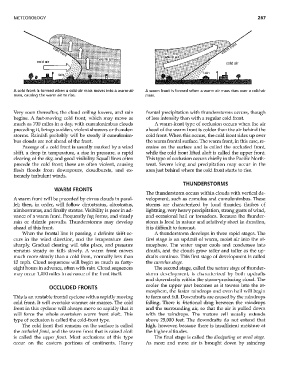
       A cold front is formed when a cold-air mass  moves into a warm-air   A warm front  is  formed when a warm  air mass  rises  over a cold-air
       mass,  causing the warm air to rise.                   mass.


       Very soon thereafte,;  the cloud ceiling lowers, and rain   frontal precipitation with thunderstorms occurs, though
       begins.  A fast-moving  cold  front,  which  may  move  as   of less intensity than with a regular cold front.
       much as 700 miles in a day, with cumulonimbus clouds       A warm-front type of occlusion occurs ,,\Then the au'
       preceding it, brings sudden, violent showers or thunder-  ahead of the warm front is colder than the air behind the
       storms. Rainfall  probably will be steady if cumulonim-  cold front. When this occurs, the cold front rides up over
       bus clouds are not ahead of the front.                 the warm frontal slu·face. The "warm front, in this case, re-
          Passage of a cold front is usually marked by a wind   mains on the  surface  and is  called  the  occluded front,
       shift, a drop in temperature, a  rise  in pressure, a  rapid   while the cold front lifted aloft is called the upper front.
       clearing of the sky, and good visibility. Squall lines often   This type of occlusion occurs chiefly in the Pacific North-
       precede the cold front;  these are  often violent,  causing   west.  Severe  icing  and precipitation  may  occur  in  the
       flash  floods  from  downpours,  cloudbursts,  and  ex-  area just behind where the cold front starts to rise.
       trenlely turbulent ·winds.
                                                                             THUNDERSTORMS
                        WARM  FRONTS
                                                              The thunderstorm occurs within clouds with vertical de-
       A warm front will be preceded by cirrus clouds in paral-  velopment, such as cumulus and cumulonimbus. These
       lel;  then!  in  ordel~ will  fallo'w  cirrostratus,  altostratus,   storms  are  characterized  by  loud  thunde,;  flashes  of
       nimbostratus, and finally stratus. Visibility is poor in ad-  lightrring, very heavy precipitation, strong gusts of wind,
       vance of a warm front. Frequently fog forms, and steady   and occasional hail or tornadoes. Because  the thunder-
       rain  or  drizzle  prevails.  Thunderstorms  may  develop   storm is local in nature and relatively short in duration,
       ahead of this front.                                   it is difficult to forecast.
          When the frontal line is passing, a definite shift oc-  A thunderstorm develops in three rapid stages. The
       curs  in  the  ,vind  direction,  and  the  tenlperatm'e  rises   first stage is an updraft of warm, moist air into the at-
       sharply.  Gradual clearing will take  place, and pressure   mosphere.  The  water  vapor  cools  and  condenses  into
       remains  steady  or  falls  slowly.  A  warm  front  moves   clouds, and the clouds grow taller and taller as the up-
       much more slowly than a cold front, normally less than   drafts continue. This first stage of development is called
       15  mph. Cloud sequences will begin as much as forty-  the cUlIlulus stage.
       eight hours in advance, often with rain. Cloud sequences   TI,e second stage, called the lIlature stage of thunder-
       may occur 1,000 miles in advance of the front itself.   storm  development,  is  characterized  by both  updrafts
                                                              and downdrafts within the storm-producing cloud. The
                                                              cooler the upper part becomes as it towers  into  the  at-
                      OCCLUDED  FRONTS
                                                              mosphere, the faster raindrops and even hail will begin
       This is an unstable frontal cyclone with a rapidly moving   to form and fall. Downdrafts are caused by the raindrops
       cold front. It will overtake warmer air masses. The cold   falling.  TI,ere  is  frictional  drag  between  the raindrops
       front in this cyclone will always move so rapidly that it   and the smrounding au; so that the air is pulled down
       will force  the  whole  overtaken warm front  aloft.  This   with  the  raindrops.  The  mature  cell  usually  extends
       type of occlusion is called the cold-front type.       above  25,000  feet.  The  downdrafts  do  not  extend  that
          The cold front that remains on the surface is called   high, however, because there  is insufficient lnoisture at
       the occluded frol1t,  and the warm front that is raised aloft   the higher altitudes.
       is  called  the  upper frol1t.  Most  occlusions  of  this  type   The final stage is called the dissipati/lg or a/lvil stage.
       occur  on  the  eastern  portions  of  continents.  Heavy   As  more  and  more  air  is  brought  down by  raindrop

