


Page 321 - NS-2 Textbook
P. 321
316                                                                                     NAUTICAL SCIENCES

          the  pile  grows,  gradually  changmg  into  heavier  ele-  and dust cloud surrOlmding a small dense core. This at-
          ments.  Evenhlally,  after  a  final  burst  in  size  and  bril-  mosphere remains  lighted by  the  core  embers.  After  a
          liance, the star either collapses or explodes and disinte-  year or two, it often can be photographed through a large
          grates, depending on its size.                         telescope  as  a  gaseous  cloud,  called  a  planetary  nebula
              Most of the bright stars we can see in a clear evening   (plural, nebulae).
          are stars in the giant or supergiant stages, edging closer
          to their last burst of gIOlY. A few are bright new ones, and
          others are ordinary ones that are close enough to appear                    NEBULAE
          very bright.
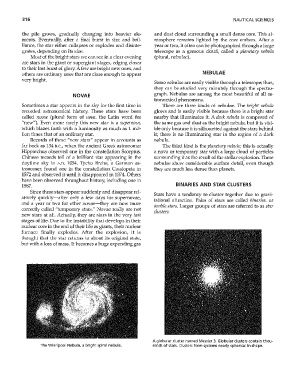
                                                                 Some nebulae are easily visible through a telescope; thus,
                                                                 they can be shldied very minutely through the spectro-
                               NOVAE                             graph. Nebulae are among the most beautiful of all as-
                                                                 tronomical phenonlena.
          Sometimes a star appears in the sky for the first time in   There  are  three kinds  of nebulae.  The  bright  nebula
          recorded  astronomical  history.  TI1ese  stars  have  been   glows and is easily visible because there is a bright star
          called  novae  (plural  form  of  nova,  the  Latin  word  for   nearby that illUl11inates it. A dark  nebula is composed of
          I1ne"w").  Even more rarely  this  new star is  a  supernova,   the same gas and dust as the bright nebula, but it is visi-
          which blazes forth with a luminosity as much as  1 mil-  ble only because it is sID10uetted against the stars behind
          lion times that of an ordinary star.                   it;  there is no illuminating star in  the  region of a  dark
              Records  of these  Hnew stal'S"  appear in accounts as   nebula.
          far back as 134 B.C., when the ancient Greek astronomer    The third kind is the planetary nebula; this is actually
          Hipparchus observed one in the constellation Scm·pius.   a nova or temporary star with a large cloud of particles
          Chinese records  tell of a  brilliant star appearing in the   surrounding it as the result of the stellar explosion. These
          daytime  sky in  A.D.  1054.  Tycho  Brahe,  a  German  as-  nebulae show considerable smface detail, even though
          tronomer,  found  one in  the  constellation Cassiopeia in   they are much less dense than planets.
          1572 and observed it until it disappeared in 1574. Others
          have been observed throughout history, including one in
          1987.                                                           BINARIES AND  STAR CLUSTERS
              Since these stars appear suddenly and disappear rel-
                                                                 Stars have a  tendency to cluster together due to gravi-
          atively quickly-after only a  few  days for  supernovae,
                                                                 tational  attraction.  Pairs  of  stars  are  called  binaries,  or
          and  a year or  two for other novae-they are  nO\l\T  more
                                                                 double stars.  Larger groups of stars are referred to as star
          correctly called "temporary stars." Novae really are not
                                                                 elusters.
          new stars at all. Actually, they are stars in the very last
          stages of life. Due to the instability that develops in their
          nuclear core in the end of their life as giants, their nuclear
          furnace  finally  explodes.  After  the  explosion,  it  is
          thought that the star returns to about its original state,
          but with a loss of mass. It becomes a huge expanding gas


                                                                 A globular cluster named Messier 3.  Globular clusters contain thou-
                  The Whirlpool Nebula, a bright spiral  nebula.   sands of stars.  Clusters form systems nearly spherical in  shape.

