


Page 326 - NS-2 Textbook
P. 326
PHYSICAL SCIENCE                                                                                      321


       are collectively called Einstein's theory of relalivity, which   of its energy back into work, thus losing energy. There is,
       he formulated early in the last cenhlTy.               therefore l  an equivalence betv-.reen ""ork and energy, in-
                                                              dicated by the fact  that they have the same lmitS:  foot-
                                                              pounds in the English system and joules in  the  metric
                            FORCES                            system.
                                                                  TIle rate at which work is done or energy is gained or
       Let us take another look at Newton's second law of mo-
                                                              expended  is  power.  In  the  English  system  the  unit  of
       tion. How do ,,;e define acceleration? Acceleration is the
                                                              pm.ver is the horsepower, and  in the metric system it is
       change in velocity per unit of time, normally one second.
                                                              the 'vatt. TIlere are 746 watts in one horsepuwer. For ex-
       Velocity is the rate of motion in a given direction. In the
                                                              ample, if 10 newtons of force acted over a distance of 10
       example above, the velocity was expressed in terms of
                                                              meters for 5 seconds, the power generated would be (10
       miles per hour. Other widely used units are feet per sec-
                                                              x  10)/5,  or  20  watts  (equivalent  to  about  .013  horse-
       ond, and in the metric systen1, meters per second or kilo-
                                                              power). A larger unit of power called the kilowatt (KW),
       meters per hour. Force can be defined as power or energy
                                                              equivalent to 1,000 watts, is commonly used, especially
       exerted against a body in a given direction. Its units are
                                                              in cOlmection with electrical power consumption. If the
       pOlmds in the English system and newtons  (N)  in  the
                                                              United  States  ever  fully  adopts  the  metric  system,  all
       metric system. Mass is the quantity of material contained
                                                              products  such  as  automobile  engines  will  be  rated  in
       in a body.  In the metric system the unit of mass  is  the
                                                              kilowatts  instead  of  horsepower.  Most American-built
       kilogram. In the English system the pound is often erro-
                                                              marine engines used on boats already use kilowatts as
       neously  used  to  indicate  mass,  although it is  really  a
                                                              their standard power units.
       force unit.
          The weight of a body is an expression of the amount
       of the force of gravity on it at a given location. Thus, the        THE  PHYSICS OF FLIGHT
       weight can change, depending on location, while mass
       does not. For example, the force of gravity on the Moon's   The path of a body in flight is determined by Newton's
       surface is  about one-sixth that of Earth. Thus, a person   laws  of motion,  according to  the forces  acting upon it.
       weighing  120  pounds  on Earth would  weigh  only  20   Some  of these  forces  are  naturat  and  others  are  man-
       pounds on the Moon. While on the way to the Moon, in   made. Various combinations of these forces produce dif-
       space where gravity is minimal, the person would have   ferent effects on the flight path. Aerodynamics is the sci-
       almost no ,veight. The person's Inass, howevel~ would be   ence  that  deals  with  the  motion  of  bodies  moving
       the same at all three locations.                       through  air  and  other  gases.  Missiles  and  aircraft  use
          One kind of force that must be dealt with for all mov-  aerodynamic forces to maintain their flight path. The sur-
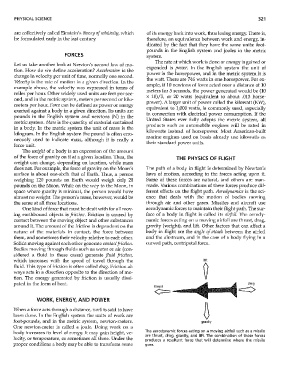
       ing earthbOlmd objects is /riclion.  Friction  is  caused by   face  of a body in flight  is called its ailfoil.  The  aerody-
       contact between the moving object and other substances   namic forces acting on a moving airfoil are thrust, drag,
       around it. The amolUlt of the friction is dependent on the   gravity (weight), and lift. Other factors that can affect a
       nature  of  the  materials  in  contact,  the  force  behveen   body in flight are the angle of attack between the airfoil
       them, and sometimes their velocity relative to each other.   and the airstream, and in the case of a body flying in a
       Solids moving against each other generate can loci friction.   clU'ved path, centripetal force.
       Bodies moving through fluids such as water or air (con-
       sidered  a  fluid  in  these  cases)  generate fluid  /riction,
       which  increases  with  the  speed  of  travel  through  the                   lift
       fluid. This type of friction is often called dmg. Friction al-
       ways acts in a direction opposite to the direction of mo-                      V
       tion.  The  energy generated by friction is usually dissi-
       pated in the form of heat.                                                                       drag
                                                                 thrust                              ==  ->
                                                                 <=

                WORK, ENERGY, AND POWER
                                                                                      ~
       When a force acts through a distance, work is said to have
       been done. In the English system the units of work are
       foot-pounds,  and in  the metric  systen1, ne'wton-meters.                    gravity
       One  n€vvtOI1-rneter  is  called  a  joule.  Doing  \vork  on a
       body increases its level of energy. It may gain height, ve-  The aerodynamic forces acting on a moving  airfoil such  as a missile
                                                              are thrust.  drag,  gravity,  and  lift. The  combination  of these  forces
       locity, or temperature, or sometimes all tlu'ee.  Under the   produces  a  resultant  force  that  will  determine  where  the  missile
       proper conditions a body may be able to transform some   goes.

