


Page 327 - NS-2 Textbook
P. 327
322                                                                                     NAUTICAL SCIENCES

                                                                 constant,  if  one element in any  system  of streamlined
                                                                 fluid flmv is decreased, another must increase to  COlU\-
                                                                 terbalance it. 111is is called Benzoulli's principle. Air flow-
           Angle of                                              ing past the fuselage or over the wing of a guided missile
           Attack
                                                                 or  aircraft forms a system to V\Thich  this theorem can be
                                                                 applied.
                                                                    When air  passes over the  streamlined convex wing
                                                                 of an  aircraft,  it must travel  a greater  distance  than  air
                                                                 passing  under it.  Since  the  two  parts  of  the  airstream
                                                                 reach the trailing edge of the wing at the same time, the
                                                                 air that flmvs over the -wing must move faster than the air
                                                      Trailing   that flows  under it.  According  to  Bernoulli's  theorem,
                                                      Edge       this results in a lower pressure on the top than on the bot-
                                                                 tom surface of the wing. This pressure difference tends to
                                                                 force the wing upward, thereby giving it lift. Since most
                                                                 missiles use flat wings rather than the curved wings of
                                                                 conventional aircraft they must get the necessary lift en-
          An  illustration of an angle of attack between the inclination of an   tirely from the angle of attack.
          airfoil and the oncoming airstream.
                                                                    Here is an example. Consider an airplane taking off
                                                                 from a runway. Before it starts rolling, its speed is zero,
             Each of the forces described above is a vector quantity,   and there is no drag. When its brakes are released, the
          meaning something that has both magnitnde (length or   force  of tluust developed by its engines at full power is
          size)  and direction.  All forces  acting  on a  body can be   unbalanced, and as a result, the plane begins to acceler-
          mathematically combined by adding their vectors to form   ate rapidly down the runway, in accordance with New-
          the resultant or net force.  The net force  determines  the   ton's  second law.  As  its speed increases,  the  lift  force
          motion of the body, in accordance with Newton's laws.   grows rapidly by Bemoulli's theorem.
             In the 1700s Daniel Bernoulli (1700-1782) postulated   As its takeoff run progresses, the plane's forward ac-
          that since the total energy in any isolated system remains   celeration gradually decreases -while speed increases, be-


                                  I    POWERED (GUIDEO'C--<'il ... -::::::===~~B:A:Ll~':STIC I FREE-FALL) ------.-11
                                  ~ PHASE                                PHASE
                                                     00'
                                                ./ SECOND  STAGE
                                             /"        SEPARATION
                                                                    APOGEE
                                           j1 <J  NOSE  FAIRING  SEPARATION
                                        /       AND  JETIISONING           REENTRY  BODY

                                      f  FIRST  STAGE  SEPARATION
                                  I __ ~ "., ~m.


                                    ---------1---------- +


                                                           ATMOSPHERE                  -... ......... -...
                                                                                                  ~
                                      ARST  STAGE  IGNITION
                        LAUNCH      y-:                                                         REENTRr
                        PHASE                                                                    PHASE
                      ~           ~[JEcnON              _____ EARTH
                                     a
                                  !
                                        :;;>
                             c=-'
                                  \1<.>-----------4000 NAUTICAL  MILES----------+j
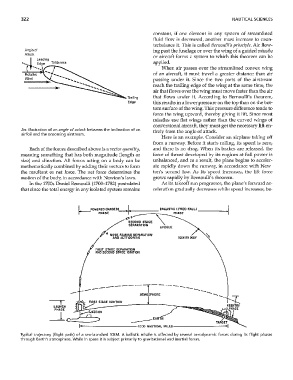
          Typical  trajectory  (flight path) of a  sea-launched  ICBM.  A  ballistic  missile  is  affected  by  several  aerodynamic  forces  during  its  flight phases
          through Earth's atmosphere. While in space  it is  subject primarily to gravitational and  inertial forces.

