


Page 34 - NS-2 Textbook
P. 34
THE  GROWTH OF AMERICAN  SEA POWER                                                                     27


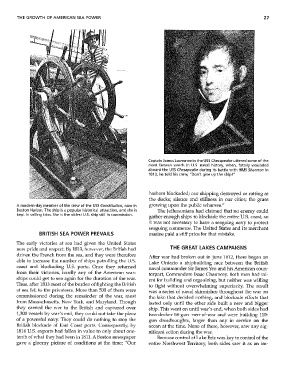
                                                               Captain James lawrence in the USS Chesapeake uttered some of the
                                                               most  famous  words  in  u.s.  naval  history,  when,  fatally  wounded
                                                               aboard the USS  Chesapeake during its battle with HMS Shannon in
                                                               1813, he told his crew,  "Don't give up the shipl"


                                                               harbors blockaded; our shipping destroyed or rotting at
                                                               the  docks;  silence  and stillness  in our cities;  the  grass
        A modern-day member of the crew of the USS Constitution  now in   growing upon the public wharves."
        Boston Harbor. The ship  is a popular historical  attraction, and she  is   The Jeffersonians had darned that no enemy could
        kept in  sailing trim, She  is  the oldest U.S.  ship still  in  commission.
                                                               gather enough ships to blockade the entire U.s. coast, so
                                                               it was not necessary to have a seagoing navy to protect
                                                               seagoing commerce. The United States and its merchant
                 BRITISH  SEA POWER PREVAILS                   marine paid a stiff price for that mistake.

        The early  victories  at sea had given  the  United  States
        new pride and respect. By 1813, howevel; the British had        THE  GREAT LAKES  CAMPAIGNS
        driven the French from  the sea, and they were therefore
                                                               After war had broken out in June 1812, there began on
        able to increase the number of ships patrolling the U.S.
                                                               Lake  Ontario  a  shipbuilding  race  between  the  British
        coast  and  blockading  U.S.  ports.  Once  they  returned
                                                               naval commander Sir James Yeo and his American cotm-
        from  their  victories,  hardly  any  of  the  American  war-
                                                               terpart, Commodore Isaac Chauncey. Both men had tal-
        ships could get to sea again for the duration of the war.   ent for building and organizing, but neither was willing
        Thus, after 1813 most of the burden of fighting the British
                                                               to  fight  without  overwhein1ing  superiority.  The  result
        at sea fell to the privateers. More than 500 of them were
                                                               was a series of naval skirmishes throughout the war on
        comn1issioned  dtu'ing  the  ren1ainder  of  the  war,  most   the lake that decided nothing, and blockade efforts that
        from Massachusetts, New York, and Matyland. TI10ugh    lasted only until the other side built a  new and bigger
        they  carried  the  war to  the  British  and  captured over   ship. This went on until war's end, when both sides had
        1,300 vessels by war's end, they could not take the place   two-decker 58-gun men-of-war and  were building 110-
        of a powerful navy.  They could  do nothing to  stop the   gun  dreadnoughts,  larger  than  any  in  service  on  the
        British blockade  of  East Coast ports.  Consequently, by   ocean at the time. None of these, however, saw any sig-
        1814 U.s. exports had fallen in value to only about one-  nificant action during the war.
        tenth of what they had been in 1811. A Boston newspaper    Because control of Lake Erie was key to control of the
        gave  a  gloomy picture of conditions at the  time:  "Our   entire  Northwest Territory,  both sides  sa\v it  as  an im-

