


Page 39 - NS-2 Textbook
P. 39
32                                                                                       MARITIME  HISTORY

         squadrons  continued  their  presence  in  the  Mediter-
         ranean,. however, operating from a base in Port Mahon,
         Minorca, to make sure that the deys and pashas did not
         revert to their old ways.
             When revolts against Spain began in South and Cen-
         tral America in the early nineteenth century, piracy in-
         creased in the West Indies. Some of the new South Amer-
         ican countries issued letters of marque (official documents
         commissioning  vessels  as  privateers)  to  their  ships.
         However, many of these ships began piracy against all
         shipping.  This  affected American shipping,  for  at  this
         time  New  Orleans  was  developing  into  the  second-
         largest port of the nation. This was a result of the west-
         ward migration and agricultural expansion in the Mis-
         sissippi Valley.
             Jean Lafitte was the most notorious American pirate.
         He established his base on an island at the mouth of the
         Mississippi River. He and his men had been given par-
         dons because of their  assistance  to  General Jackson  at
         New Orleans in 1815, but they returned to piracy after
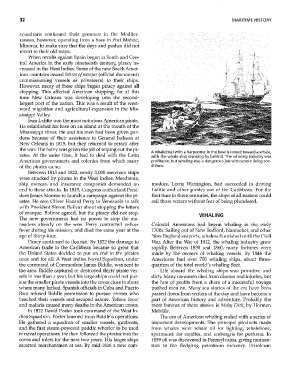
         the war. The Navy was given the job of wiping out the pi-  A whaleboat with a harpooner in the bow is rowed toward a whale,
         rates.  At  the  same  time,  it had to  deal with the  Latin   with the whale ship standing by  behind. The whaling industry was
         American governments and colonies from which many      profitable, but whaling was a dangerous job with severe living con-
         of the pirates came.                                   ditions.
             Between 1815 and 1822, nearly 3,000 merchant ships
         were attacked by pirates in the West Indies. Merchants,
         ship  owners,  and  insurance  companies  demanded  an   madore,  LeV\Tis  Warrington,  had  succeeded  in driving
         end to these attacks. In 1819, Congress authorized Presi-  Lafitte  and other pirates out of the  Caribbean.  For  the
         dent James Momoe to launch a campaign against the pi-  first time in three centuries, the ships of all nations could
         rates. He sent Oliver Hazard Perry to Venezuela to talk   sail those waters without fear of being plundered.
         with President Simon Bolivar about stopping the letters
         of marque. Bolivar agreed, but the piracy did not stop.                    WHALING
         The  new  governments  had no  power  to  stop  the  ma-
         rauders  already  on  the  seas.  Perry  contracted  yellow   Colonial  Americans  had  begtm  whaling  in  the  early
         fever during his mission, and died the same year at the   1700s. Sailing out of New Bedford, Nantucket, and other
         age of thirty-four.                                    New England seaports, whalers flourished until the Civil
             Piracy continued to flourish. By 1822 the damage to   War.  After the War of 1812,  the whaling industry grew
         American trade in  the Caribbean became so  great that   rapidly.  Between  1830  and  1860,  many  fortunes  were
         the United States decided to put an end to the pirates   made  by  the  owners  of  whaling  vessels.  By  1846  the
         once and for all. A West Indies Naval Squadron, under   Americans  had  over  700  whaling  ships,  about  three-
         the command of Commodore James Biddle, was sent to     quarters of the total world's whaling fleet.
         the area. Biddle captured or destroyed thirty pirate ves-  Life  aboard  the  whaling  ships  was  primitive  and
         sels in less than a year, but his large ships could not pur-  dirty. Many crewmen died from disease and injuries, but
         sue the smaller pirate vessels into the coves close to shore   the lure  of profits from  a  share of a  successful  voyage
         where many lurked. Spanish officials in Cuba and Puerto   pushed men on. Many sea stories of the era have been
         Rico  refused  Biddle permission to pursue pirates who   passed down from writers of the day and have become a
         beached their vessels and escaped ashore. Yellow fever   part of American history  and  adventure.  Probably  the
         and malaria caused many deaths in the American crews.   most famous  of these  stories is Moby Dick,  by Herman
             In 1822 David Porter took command of the West In-  Melville.
         dies Squadron. Porter learned from Biddle's operations.    TIle era of American whaling ended with a series of
         He  gathered  a  squadron of  smaller vessels,  gunboats,   important developments.  The  principal products made
         and the first steam-powered paddle wheeler to be used   from  whales  were  whale  oil  for  lighting,  whalebone,
         in naval operations. He then followed the pirates into the   spermaceti for  candles, and  ambergris  for  perfume.  In
         coves and inlets for the next two years. His larger ships   1859 oil ,\-vas discovered in Pennsylvania, giving momen-
         escorted merchantmen at sea.  By mid-1826 a new com-   tum  to  the  fledgling  petrolemll  industry.  Petroleum

