


Page 156 - fbkCardioDiabetes_2017
P. 156
132         Cardiovascular Risk In Diabetes: Known v/s Unknown


              tients with acute coronary  syndrome  (ACS) could   higher CVD morbidity and mortality than the late on-
              help in detecting the correct glycemic category than   set patients with  T2DM . We studied the prevalence
                                                                                      5
              testing them with FPG alone. We studied clinical util-  and pattern of modifiable CVD risk factors including
              ity of testing for HBA1c in detecting pre-diabetes and   major lipid fractions and systolic and diastolic blood
              diabetes  among  patients without  the previous  diag-  pressure in patients with newly diagnosed T2DM and
              nosis of diabetes admitted to hospital with ACS.   to detect  possible  association  of these risk  factors
                                                                 with gender, age at onset of diabetes, central obesity
              In this cross sectional study conducted in a medical   (measured as waist circumference) and global obesi-
              ward of a tertiary care hospital in Southern Sri Lan-  ty (measured as body mass index). (Table 1)
              ka, we included all male and female patients with no
              previous  history of diabetes admitted  over a period   From a database which included demographic, clini-
              of three months with any of the three types of acute   cal and biochemical data of patients who underwent
              coronary  syndrome;  ST  elevation myocardial infarc-  screening in a diabetes clinic at  the  time of first di-
              tion, non-ST elevation myocardial infarction and un-  agnosis  of T2DM before  commencing  any hypogly-
              stable angina.                                     cemic,  anti  -hypertensive  or  lipid  lowering  therapy,
                                                                 we obtained data on their demographic (gender, age)
              Of the 125 patients studied, 99  (80%)  had normal   clinical (height, weight, waist circumference, systolic
              fasting plasma glucose (< 125 mg/ dL), 20 (16%) had   and diastolic blood  pressure)  and biochemical  (to-
              impaired  fasting  glucose  (IFG) (FPG100- 124mg /dL)   tal  cholesterol, low density lipoproteins  (LDL),  tri-
              and  6  (4%)  were  newly diagnosed to  have  diabetes   glycerides (TG), high density lipoprotein levels (HDL)
              based on FPG. HbA1c levels of all 6 newly diagnosed   for analysis. Optimal cutoff levels for blood pressure
              patients with diabetes according to FPG ranged from   and  lipids  recommended by the American diabetes
              7 –  8.9%.  Based  on HbA1c,  59 (47%)  had diabetes   association (ADA) were used to determine the prev-
              (HbA1c > 6.5%) and 66 (53%) were in the category of   alence of each cardiovascular risk  factor needing
              pre - diabetes (HbA1c5.5- 6.5%) and none of the study   therapeutic intervention. The proportions with systolic
              subjects presenting with ACS had HbA1c level below   blood  pressure  ( SBP>  140 mm Hg),  diastolic blood
              5.5% to be categorized as having normal blood glu-  pressure ( DBP>90 mm Hg) , low density lipoprotein
              cose (Table 1). Out of the 66 in the pre-diabetes cat-  level ( LDL > 100 mg/ dL) , triglycerides( TG> 150 mg/
              egory  according to HbA1c, only 7 subjects had FPG   dL)  and  high  density  lipoprotein  level  ( HDL  <  40
              in the range of IFG (100-124mg/dL) , leaving 59 (89%)   mg/ dL in males and < 50 mg/ dL in females) were
              patients with pre-diabetes  on HbA1C  having normal   estimated. Logistic regression analysis  was used to
              FPG (< 100 mg / dL).
                                                                 study the association of age, gender, body mass in-
              Finding of eight fold (6  vs 50) increase  of number   dex (BMI) and waist circumference with each of the
              of patients with diabetes and two and a half fold in-  modifiable cardiovascular risk  factor.  Age  adjusted
              crease in the  category with  pre-diabetes  by testing   odds  ratios  were  calculated  for  each parameter  risk
              for HbA1c compared to FPG among  patients in this   and level  below 0.05 was taken as statistically sig-
              study challenges the diagnostic utility of FPG in cor-  nificant.  Characteristics  of the  study sample (n=412)
              rectly recognizing the  glycemic status  of individuals   and the results  from regression  analysis  are  shown
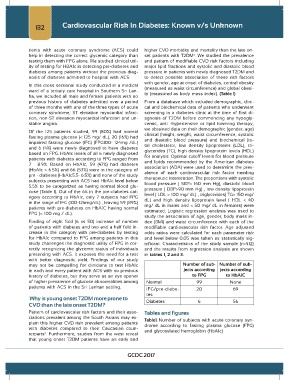
              presenting  with ACS.  It exposes the need  for  a test   in tables 1, 2 and 3.
              with  better diagnostic yield. Findings of our study
              may not be  compelling  for  clinicians to test HbA1c               Number of sub- Number of sub-
              in each and every patient with ACS with no previous                 jects according   jects according
              history of diabetes, but they serve as an eye opener                    to FPG         to HbA1C
              of higher prevalence of glucose abnormalities among   Normal              99            None
              patients with ACS in the Sri Lankan setting.
                                                                  IFG/pre-diabe-        20              69
                                                                  tes
               Why is young onset T2DM more prone to              Diabetes              6               56
              CVD than the late onset T2DM?
              Pattern of cardiovascular risk factors and their asso-  Tables and figures
              ciations prevalent among the South Asians may ex-  Table1. Number of subjects with acute coronary syn-
              plain this higher CVD risk prevalent among patients   drome according to fasting plasma glucose (FPG)
              with diabetes  compared  to their  Caucasian  coun-  and glycosylated hemoglobin (HbA1c)
              terparts . Furthermore,  studies from the  west reveal
                     4
              that  young onset T2DM patients have an early  and


                                                         GCDC 2017

