


Page 300 - fbkCardioDiabetes_2017
P. 300
276                          Hypoglycemia How Critical it is?


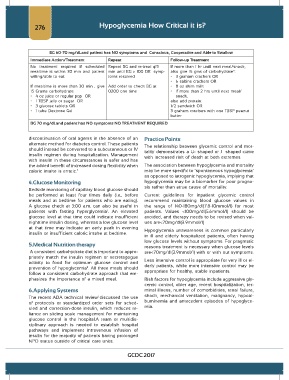
                       BG 60-70 mg/dLand patient has NO symptoms and  Conscious, Cooperative and Able to Swallow
              Immediate Action/Treatment         Repeat                     Follow-up Treatment
              No  treatment  required  if  scheduled  Repeat BG and re-treat q15   If more than 1 hr until next meal/snack,
              mealtime is  within 30 min and patient  min until BG > 100 OR  symp-  also give 15 gms of carbohydrate*:
              willing/able to eat.               toms resolved              •  3 graham crackers OR
                                                                            •  6 saltine crackers OR
              If  mealtime is  more  than  30 min , give  Add order to check BG at   •  8 oz skim milk
              15 Grams carbohydrate:             0200 one time              •  If more than 2 hrs until next meal/
              •  4 oz juice or regular pop  OR                                 snack.
              •  1 TBSP jelly or sugar  OR                                  also add protein:
              •  3 glucose tablets OR                                       1/2 sandwich OR
              •  1 tube Dextrose Gel                                        3 graham crackers with one TBSP peanut
                                                                            butter
              BG 70 mg/dLand patient has NO symptoms NO TREATMENT REQUIRED


              discontinuation  of oral agents in the absence of an   Practice Points
              alternate method for diabetes control. These patients   The relationship between glycemic control and mor-
              should instead be converted to a subcutaneous or IV   tality demonstrates a U-  shaped or J –shaped curve
              insulin regimen  during  hospitalization. Management   with increased risk of death at both extremes.
              with insulin in these circumstances is safer and has
              the added benefit of increased dosing flexibility when   The association between hypoglycemia and mortality
              caloric intake is erratic. 2                       may be more specific to ‘spontaneous hypoglycemia’
                                                                 as opposed to iatrogenic hypoglycemia, implying that
              4.Glucose Monitoring                               hypoglycemia may be a biomarker for poor progno-
                                                                 sis rather than atrue cause of mortality.
              Bedside monitoring of capillary blood glucose should
              be performed  at least four times daily  (i.e., before   Current guidelines  for  inpatient glycemic  control
              meals and  at  bedtime for patients  who  are eating).   recommend maintaining  blood glucose  values in
              A glucose  check at  3:00  a.m. can  also be useful in   the range  of 140-180mg/dl(7.8-10mmol/l)  for  most
              patients with  fasting hyperglycemia . An elevated   patients. Values <100mg/dl(5.6mmol/l)  should be
                                                1
              glucose level at  that  time could  indicate  insufficient   avoided, and therapy needs to be revised when val-
              nighttime insulin dosing, whereas a low glucose level   ues are<70mg/dl(3.9mmol/l)
              at that  time may indicate an early  peak  in evening   Hypoglycemia  unawareness is  common  particularly
              insulin or insufficient caloric intake at bedtime.
                                                                 in ill  and elderly  hospitalized patients, often having
                                                                 low glucose levels without symptoms. For pragmatic
              5.Medical Nutrition therapy                        reasons treatment is necessary when glucose levels
               A consistent carbohydrate diet is important to appro-  are<70mg/dl(3.9mmol/l) with or with out symptoms.
              priately  match  the insulin regimen  or  secretagogue   Less intensive control is appropriate for very ill or el-
              activity  to food for optimum  glucose control  and   derly  patients, while more intensive control  may be
              prevention of hypoglycemia . All three meals should   appropriate for healthy, stable inpatients.
                                       3
              follow a consistent carbohydrate approach that em-
              phasizes the importance of a mixed meal.           Risk factors for hypoglycemia include aggressive gly-
                                                                 cemic  control, older  age,  recent hospitalization,  ter-
              6.Applying Systems                                 minal illness, number of comorbidities, renal failure,
              The  recent ADA  technical  review discussed  the use   shock, mechanical  ventilation,  malignancy, hypoal-
                                            1
              of protocols or standardized order  sets for sched-  buminemia  and  antecedent  episodes  of  hypoglyce-
              uled and correction-dose insulin,  which  reduces re-  mia.
              liance on sliding scale management for maintaining
              glucose control in the hospital.A team  or  multidis-
              ciplinary  approach  is  needed to establish hospital
              pathways and  implement intravenous infusion of
              insulin for the majority of patients having prolonged
              NPO status outside of critical care units.


                                                         GCDC 2017

