


Page 321 - fbkCardioDiabetes_2017
P. 321
Double Trouble - Diabetes and Heart Disease (CAD)                               297


                 sity to increased coagulability. Diabetics have higher   also been observed in patients  with  diabetes based
                 rates  of  platelet  activation,  and increased    levels  of   on Doppler studies. Interstitial fibrosis with increased
                 tissue plasminogen activator inhibitor type 1, leading   collagen deposition has been postulated as contrib-
                 to accelerated thrombus formation and reduced  ly-  uting to the altered  mechanics.  The  prevalence  of
                 sis of clot. Moreover, proteinuria due to diabetic ne-  heart failure,  especially  heart failure  with preserved
                 phropathy can reduce the levels of protein C and an-  ejection fraction(16-31%)  is  higher  among diabetics
                 ti-thrombin III,  furthering the pro-coagulant state. (3)  than  the general  population  (4-6%).    Thus diabetes
                                                                    per  se  independently influences cardiac  structure
                 Silent Ischemia                                    and function by promoting hypertrophy and fibrosis.
                 Some diabetics may have a blunted  pain response
                 to ischemia, which may result in atypical symptoms.
                 This may result in silent ischemic insult to the cardiac
                 musculature  and eventually, silent  infarction.   Silent
                 ischemia is  far  more  prevalent  in patients with DM
                 (10%-20%)  than  those without  DM (1%-4%)  and  may
                 have a male predilection.  Silent Myocardial infarction
                 may contribute  to the  higher rates of morbidity and
                 mortality in cardiovascular disease among diabetics.
                 Silent  ischemia is  partly  explained by  the autonom-
                 ic neuropathy seen in diabetes.  The astute clinician
                 therefore, must have a low threshold for suspecting
                 cardiac  ischemia in a diabetic  patient  with  atypical
                 symptoms  and early evaluation is prudent.

                 Asymptomatic disease:
                 People with diabetes have higher rates of asymptom-
                 atic disease (11 to 60%). This has been studied based
                 on the presence of coronary artery calcification (CAC)
                 on electron beam CT scanning and by inducible silent
                 ischemia on stress imaging. The American Diabetes
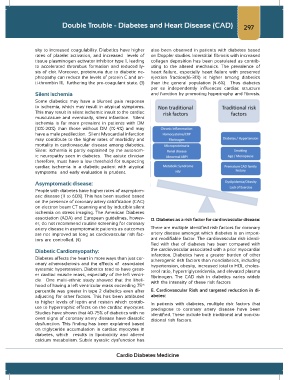
                 association (ADA) and European guidelines, howev-  D. Diabetes as a risk factor for cardiovascular disease:
                 er, do not recommend routine screening for coronary
                 artery disease in asymptomatic patients as outcomes   There are multiple identified risk factors for coronary
                 are not improved as long as cardiovascular risk fac-  artery disease amongst which diabetes is an import-
                 tors are controlled. (4)                           ant modifiable factor. The cardiovascular risk identi-
                                                                    fied with  that  of diabetes has been compared with
                 Diabetic Cardiomyopathy:                           the cardiovascular associated with a prior myocardial
                                                                    infarction. Diabetics have a  greater  burden  of  other
                 Diabetes affects the heart in more ways than just cor-  atherogenic risk factors than nondiabetics, including
                 onary atherosclerosis and the effects of  associated   hypertension, obesity, increased total to HDL choles-
                 systemic hypertension. Diabetics tend to have great-  terol ratio, hypertriglyceridemia, and elevated plasma
                 er cardiac muscle mass, especially of the left ventri-  fibrinogen.  The CAD risk  in diabetics varies  widely
                 cle.  One multi-ethnic  study showed that  the likeli-  with the intensity of these risk factors
                                                                th
                 hood of having a left ventricular mass exceeding 75
                 percentile was greater in type 2 diabetics even after   E. Cardiovascular Risk  and  targeted reduction in di-
                 adjusting for other factors. This has been attributed   abetes:
                 to higher  levels  of  leptin  and  resistin  which  contrib-  In patients  with  diabetes, multiple risk  factors that
                 ute to hypertrophic effects on the cardiac myocytes.   predispose  to coronary artery  disease  have  been
                 Studies have shown that 40-75% of diabetics with no   identified. These include both traditional and non-tra-
                 overt signs of coronary artery disease have diastolic   ditional risk factors.
                 dysfunction.  This  finding  has been  explained  based
                 on triglyceride accumulation in cardiac  myocytes in
                 diabetes,  which  results  in lipotoxicity  and altered
                 calcium metabolism. Subtle systolic dysfunction has


                                                    Cardio Diabetes Medicine

