


Page 336 - fbkCardioDiabetes_2017
P. 336
312                          International  Lipid Guidelines :
                                               What Is Needed For Indians ?


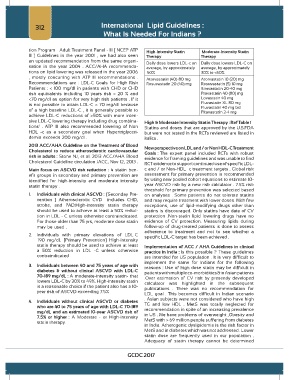
              tion Program – Adult Treatment Panel - III [ NCEP ATP   High-Intensity Statin    Moderate-Intensity Statin
              III  ] Guidelines in the year  2001  , we had  also seen   Therapy          Therapy
              an updated recommendation from the same organi-     Daily dose lowers LDL-c on  Daily dose lowers LDL-C on
              sation in the year  2004  . ACC/AHA  recommenda-    average, by approximately   average, by approximately
              tions on lipid lowering was released in the year 2006   ≥50%                30% to <50%
              , mostly  concurring  with ATP  III  recommendations .   Atorvastatin (40)-80 mg  Atorvastatin 10 (20) mg
              Recommendations  are  :  LDL-C  Goals  for  High  Risk   Rosuvastatin 20 (40) mg  Rosuvastatin (5) 10 mg
              Patients : < 100 mg/dl in patients with CHD or CHD                          Simvastatin 20-40 mg
              risk  equivalents  including 10 years  risk  >  20 % and                    Pravastatin 40 (80) mg
              <70 mg/dl as option for very high risk patients . If it                     Lovastatin 40 mg
              is not possible to attain LDL-C < 70 mg/dl because                          Fluvastatin XL 80 mg
              of a high baseline LDL-C , it is generally possible to                      Fluvastatin 40 mg bid
                                                                                          Pitavastatin 2-4 mg
              achieve LDL-C reductions of >50% with more inten-
              sive LDL-C lowering therapy including drug combina-  High & Moderate Intensity Statin Therapy : Ref Table 1
              tions  . ATP  III  also  recommended lowering  of Non   Statins and doses that are approved by the U.S.FDA
                  1
              HDL  -c as a secondary goal when  Hypertriglyceri-  but were not tested in the RCTs reviewed are listed in
              demia exceeds 200 mg/dl .                          italics .
              2013 ACC/AHA Guideline on the Treatment of Blood   New perspective on LDL and / or Non HDL-C Treatment
              Cholesterol  to reduce atherosclerotic  cardiovascular   Goals : The  expert  panel  included RCTs  with robust
              risk in adults : Stone NJ, et al. 2013 ACC/AHA Blood   evidence for framing guidelines and was unable to find
              Cholesterol Guideline circulation JACC, Nov 12, 2013 .   RCT evidence to support continued use of specific LDL-
              Main focus on ASCVD risk reduction : 4 statin  ben-  c and / or Non-HDL –c treatment targets . Global risk
              efit groups in secondary and primary prevention are   assessment for primary prevention is recommended
              identified for high-intensity and  moderate intensity   by using new pooled cohort equations to estimate 10-
              statin therapy .                                   year ASCVD risk by a new risk calculator . 7.5% risk
                                                                 threshold for primary prevention was selected based
              1.   Individuals with clinical ASCVD : [Seconday Pre-  on analyses  .  Some  patients do  not tolerate  statins
                 vention  ]  Atherosclerotic CVD   includes  CHD,   and may require treatment with lower doses. With few
                 stroke,  and  PAD:High-intensity statin  therapy   exceptions,  use  of  lipid-modifying  drugs  other  than
                 should be used to achieve at least a 50% reduc-  statins is discouraged. Only statins have data of CV
                 tion in LDL - C unless otherwise contraindicated.   protection .Non-statin lipid  lowering  drugs  have no
                 For those older than 75 yrs, moderate dose statin   evidence of  CV  protection. Measuring  lipids  during
                 may be used .                                   follow-up of drug-treated patients is done to assess
                                                                 adherence to treatment  and not  to see  whether  a
              2.  Individuals with primary  elevations of  LDL–C   specific LDL-C target has been achieved .
                 ≥190  mg/dL  [Primary  Prevention]  High-intensity
                 statin therapy should be used to achieve at least   Implementation of ACC / AHA Guidelines in clinical
                 a 50% reduction in LDL  -C unless  otherwise    practice in India : Is this possible ? These guidelines
                 contraindicated                                 are intended for US population . It is very difficult to
                                                                 implement the same for Indians for the  following
              3.  Individuals between 40 and 75 years of age with   reasons : Use of high dose statin may be difficult in
                 diabetes  & without  clinical  ASCVD  with LDL-C   patients with multiple co-morbidities & in Asian patients
                 70-189 mg/dL : A moderate-intensity statin- that   .Over estimation  of CV risk by presently  developed
                 lowers LDL-C by 30% to 49%. High-intensity statin   calculator  was  highlighted in the subsequent
                 is a reasonable choice if the patient also has a 10-  publications .  There  was  no recommendation  for
                 year risk of ASCVD exceeding 7.5%
                                                                 LDL  goal  .  This  becomes  difficult in Indian scenario
                                                                 . Asian subjects were not considered who have high
              4.  Individuals  without clinical  ASCVD  or diabetes
                 who are 40 to 75 years of age with LDL-C 70-189   TG and  low HDL . MetS was totally neglected for
                 mg/dL and an estimated 10-year ASCVD risk of    recommendation in spite of an increasing prevalence
                 7.5% or higher : A Moderate  - or  High-intensity   in US . We have problems of overweight ,Obesity and
                 statin therapy.                                 MetS with > 69 million people suffering from diabetes
                                                                 in India. Atherogenic dyslipidemia is the risk factor in
                                                                 MetS and in diabetes which was not addressed . Lower
                                                                 statin dose  are  frequently  used  in our  population  .

                                                                 Adequacy  of statin therapy  cannot  be  determined

                                                         GCDC 2017

