


Page 344 - fbkCardioDiabetes_2017
P. 344
320                      Cardio Diabetes Medicine 2017


              GDM                                                Weight gain in Pregnancy

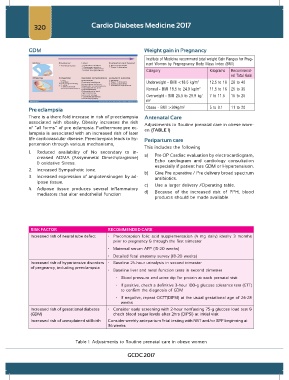
                                                                  Institute of Medicine recommend total weight Gain Ranges for Preg-
                                                                  nant Women by Prepregnancy Body Mass Index (BMI)
                                                                  Category                   Kilograms  Recommend-
                                                                                                       ed Total Gain
                                                                  Underweight - BMI <18.5 kg/m 2  12.5 to 18  28 to 40
                                                                  Normal - BMI 18.5 to 24.9 kg/m 2  11.5 to 16  25 to 35
                                                                  Overweight - BMI 25.5 to 29.9 kg/  7 to 11.5  15 to 25
                                                                  m 2
              Pre eclampsia                                       Obese - BMI >30kg/m 2      5 to 9.1  11 to 20
              There is a there fold increase in risk of preeclampsia   Antenatal Care
              associated with  obesity.  Obesity increases  the risk   Adjustments to Routine prenatal care in obese wom-
              of “all forms” of pre eclampsia. Furthermore pre ec-  en (TABLE 1)
              lampsia is associated with an increased risk of later
              life cardiovascular disease. Preeclampsia leads to hy-  Peripartum care
              pertension through various mechanisms,
                                                                 This includes the following
              1.   Reduced availability  of No  secondary  to in-
                 creased  ADMA  (Assymmetic Dimethylarginine)    a)   Pre OP Cardiac evaluation by electrocardiogram,
                 & oxidative Stress.                                 Echo cardiogram and cardiology  consultation
                                                                     especially if patient has GDM or Hypertensiuon.
              2.  Increased Sympathetic tone.                    b)   Give Pre operative / Pre delivery broad spectrum
              3.  Increased expression of angiotensinogen by ad-     antibiotics.
                 ipose tissue.
                                                                 c)   Use a larger delivery /Operating table.
              4.  Adipose  tissue  produces  several  inflammatory
                 mediators that alter endothelial function       d)   Because of the  increased risk  of PPH, blood
                                                                     products should be made available.


               RISK FACTOR                       RECOMMENDED CARE
               Increased risk of neural tube defect  •  Preconception folic acid  supplementation  (4  mg daily) ideally  3 months
                                                   prior to pregnancy & through the first trimester
                                                 •  Maternal serum AFP (15-20 weeks)
                                                 •  Detailed fetal anatomy survey (18-20 weeks)
               Increased risk of hypertensive disorders   •  Baseline 24-hour urinalysis in second trimester
               of pregnancy, including preeclampsia
                                                 •  Baseline liver and renal function tests in second trimester
                                                    •  Blood pressure and urine dip for protein at each prenatal visit
                                                    •  If positive, check a definitive 3-hour 100-g glucose tolerance test (GTT)
                                                      to confirm the diagnosis of GDM
                                                    •  If negative, repeat OGTT(DIPSI) at the usual gestational age of 24-28
                                                      weeks
               Increased risk of gestational diabetes   •  Consider early screening with 2-hour nonfasting 75-g glucose load test &
               (GDM)                               check blood sugar levels after 2hrs (DIPSI) at initial visit
               Increased risk of unexplained stillbirth   Consider weekly antepartum fetal testing with NST and/or BPP beginning at
                                                 36 weeks


                                  Table 1: Adjustments to Routine prenatal care in obese women


                                                         GCDC 2017

