


Page 443 - fbkCardioDiabetes_2017
P. 443
Don’t Let Diabetes Pull Down Our Foot                                  419


                 been many treatment options for diabetic ulcer, op-
                 timal results are yet to be obtained.

                 There  are  various  strategies  in  wound dressing  to
                 facilitate wound  healing.  If  the standard treatment
                 fails  to heal the Diabetic  foot ulcer, supplementary
                 and advanced treatment  modalities  would be  re-
                 quired.  They  are  comparatively effective and  have
                 minimal  side  effects. They are collagen products
                 (COL),  biological skin  equivalents (BSE), biological
                 dressings  (BD), silver  products,  intermittent  pneu-
                 matic  compression  therapy  (IPC), negative pressure
                 wound  therapy  (NPWT), electromagnetic therapy
                 (EMT), keratinocytes,  platelet-derived  growth factor
                 (PDGF), platelet-rich plasma (PRP), hyperbaric oxygen
                 (HBOT),  topical oxygen,  Honey  dressing  and  ozone
                 oxygen etc.

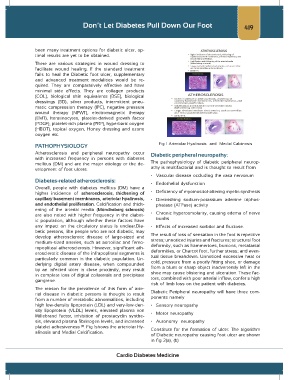
                 PATHOPHYSIOLOGY                                       Fig 1 Arteriolar Hyalinosis  and  Medial Calcinosis
                 Atherosclerosis  and peripheral  neuropathy occur   Diabetic peripheral neuropathy:
                 with increased  frequency  in persons  with diabetes
                 mellitus (DM)  and  are the  major etiology  or the  de-  The  pathophysiology  of diabetic peripheral  neurop-
                 velopment of foot ulcers.                          athy is multifactorial and is thought to result from
                                                                    •  Vascular disease occluding the vasa nervorum
                 Diabetes-related atherosclerosis:
                                                                    •  Endothelial dysfunction
                 Overall, people  with diabetes  mellitus (DM)  have a
                 higher  incidence of  atherosclerosis, thickening  of   •  Deficiency of myoinositol-altering myelin synthesis
                 capillary basement membranes, arteriolar hyalinosis,   •  Diminishing sodium-potassium adenine triphos-
                 and endothelial proliferation. Calcification and thick-  phatase (ATPase) activity
                 ening  of  the arterial  media  (Mönckeberg sclerosis)
                 are  also  noted with higher  frequency  in  the diabet-  •  Chronic hyperosmolarity, causing edema of nerve
                 ic population, although whether these  factors have   trunks
                 any impact  on the  circulatory status  is unclear.Dia-  •  Effects of increased sorbitol and fructose.
                 betic persons, like people who are not diabetic, may
                 develop  atherosclerotic disease of large-sized  and   The result of loss of sensation in the foot is repetitive
                 medium-sized arteries, such as aortoiliac and femo-  stress; unnoticed injuries and fractures; structural foot
                 ropopliteal atherosclerosis. However, significant ath-  deformity, such as hammertoes, bunions, metatarsal
                 erosclerotic disease of the infrapopliteal segments is   deformities, or Charcot foot, further stress; and even-
                 particularly  common in the diabetic population.  Un-  tual  tissue breakdown. Unnoticed  excessive  heat  or
                 derlying  digital  artery  disease,  when compounded   cold, pressure from a poorly fitting shoe, or damage
                 by  an infected ulcer in close  proximity,  may result   from a blunt or sharp object inadvertently left in the
                 in complete loss of digital collaterals and precipitate   shoe may cause blistering and ulceration. These fac-
                 gangrene.                                          tors, combined with poor arterial inflow, confer a high
                                                                    risk of limb loss on the patient with diabetes.
                 The reason for the  prevalence of this form of arte-
                 rial  disease  in diabetic  persons  is  thought  to result   Diabetic  Peripheral  neuropathy will  have three com-
                 from a number of metabolic abnormalities, including   ponents namely
                 high low-density lipoprotein (LDL) and very-low-den-  •  Sensory neuropathy
                 sity  lipoprotein (VLDL) levels,  elevated plasma von   •  Motor neuropathy
                 Willebrand factor, inhibition of prostacyclin synthe-
                 sis, elevated plasma fibrinogen levels, and increased   •  Autonomy  neuropathy
                 platelet adhesiveness  . Fig 1shows the arteriolar Hy-  Constitute  for  the formation of  ulcer.  The  algorithm
                                     (2)
                 alinosis and Medial Calcification.
                                                                    of Diabetic neuropathy causing foot ulcer are shown
                                                                    in fig 2(a), (b)


                                                    Cardio Diabetes Medicine

