


Page 508 - fbkCardioDiabetes_2017
P. 508
484                   Newer Guidelines on Cardiac Arrest in Nutshell


              rescuers to perform chest compressions at a rate of   ported  an association between excessive  compres-
              100 to 120/min.                                    sion depth and injuries that were not life-threatening.
                                                                 Most monitoring via CPR feedback devices suggests
              2010 (Old):                                        that  compressions  are  more  often too shallow  than
                                                                 they are too deep.
              : It is reasonable for lay rescuers and HCPs toperform
              chest compressions at a rate of at least 100/min.
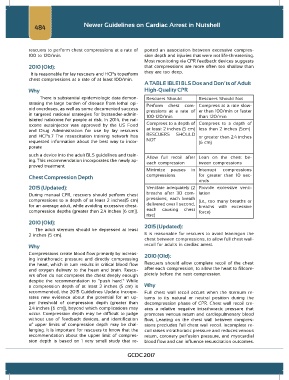
                                                                 A TABLE 1BLE1 BLS Dos and Don’ts of Adult
              Why                                                High-Quality CPR
              Why: There is substantial epidemiologic data demon-  Rescuers Should       Rescuers Should Not
              strating the large burden of disease from lethal opi-  Perform  chest com- Compress at a rate slow-
              oid overdoses, as well as some documented success   pressions  at a rate of  er than 100/min or faster
              in targeted national  strategies  for bystander-admin-  100-120/min        than 120/min
              istered naloxone for people at risk. In 2014, the nal-
              oxone  autoinjector was approved  by  the US  Food   Compress to a depth of  Compress  to a depth  of
              and Drug  Administration for  use  by  lay  rescuers   at least 2 inches (5 cm)  less than 2 inches (5cm)
              and HCPs.7  The resuscitation training  network  has   RESCUERS  SHOULD    or greater than 2.4 inches
              requested  information about the best  way  to incor-  NOT                 (6 cm)
              porate
              such a device into the adult BLS guidelines and train-  Allow full recoil after  Lean on the chest be-
              ing. This recommendation incorporates the newly ap-  each compression      tween compressions
              proved treatment.
                                                                  Minimize  pauses   in Interrupt  compressions
              Chest Compression Depth                             compressions           for  greater  than  10 sec-
                                                                                         onds
              2015 (Updated):                                     Ventilate adequately (2  Provide  excessive  venti-
              During manual  CPR, rescuers  should perform  chest   breaths after 30 com- lation
              compressions  to a depth of at least  2 inches(5 cm)   pressions,  each breath   (i.e., too many breaths or
              for an average adult, while avoiding excessive chest-  delivered over 1 second,   breaths with excessive
              compression depths (greater than 2.4 inches [6 cm]).  each  causing  chest  force)
                                                                  rise)
              2010 (Old):
              d):  The  adult sternum should be  depressed  at least   2015 (Updated):
              2 inches (5 cm).                                   It is  reasonable  for  rescuers  to avoid leaningon the
                                                                 chest between compressions, to allow full chest wall-
              Why                                                recoil for adults in cardiac arrest.
              Compressions create blood flow primarily by increas-  2010 (Old):
              ing intrathoracic pressure  and  directly compressing
              the heart, which in turn results in critical blood flow   Rescuers  should  allow complete  recoil  of the chest
              and oxygen  delivery  to the heart and brain. Rescu-  after each compression, to allow the heart to fillcom-
              ers often do not compress the chest deeply enough   pletely before the next compression.
              despite  the recommendation to “push  hard.” While
              a compression  depth  of  at least  2  inches (5 cm)  is  Why
              recommended, the 2015 Guidelines Update incorpo-   Full chest  wall recoil  occurs when the sternum re-
              rates  new evidence about  the potential for  an up-  turns  to  its natural  or neutral position during the
              per  threshold of compression  depth (greater  than   decompression phase of CPR. Chest wall recoil cre-
              2.4 inches [6 cm]), beyond which complications may   ates a relative  negative intrathoracic  pressure  that
              occur.  Compression  depth may be difficult  to  judge   promotes venous return and cardiopulmonary blood
              without  use of feedback devices, and  identification   flow. Leaning  on the chest wall between compres-
              of  upper  limits  of  compression  depth  may  be  chal-  sions precludes full chest wall recoil. Incomplete re-
              lenging. It is important for rescuers to know that the   coil raises intrathoracic pressure and reduces venous
              recommendation  about  the upper  limit of compres-  return, coronary perfusion pressure, and myocardial
              sion depth is  based  on 1 very  small study that  re-  blood flow and can influence resuscitation outcomes.


                                                         GCDC 2017

