


Page 528 - fbkCardioDiabetes_2017
P. 528
504                  Hyperglycemia & Glycemic  Control In  ICU


              balance stability and responsiveness, result in mini-  1)  any change in insulin infusion rate (i.e. BG out  of
              mal rates of hypoglycemia, and clearly communicate   target range)
              titration instructions and frequency of blood glucose   2) significant changes in clinical condition
              monitoring.
                                                                  3) initiation/cessation of pressor/steroid,  renal re-
              The  Yale insulin  Drip protocol  encompasses  all  of   placement  therapy, nutritional  support  (TPN, PPN,
              these  elements.This  protocol  is  associated with a   tube feedings, etc.)
              low incidence  of both  severe  and moderate hypo-
              glycemia.                                          Calculate TDD :
              Initially, blood glucose monitoring should occur hour-  1.   Units of insulin given in last 6 hours -8hours
              ly  until  blood glucose  reaches the target range  and   2.  Use 80% of of the calculated Total dose of insulin
              remains within range for 2 to 3 hours; then blood glu-
              cose monitoring can occur every 2 hours.When blood   3.  Use 50% Basal & 50% Bolus insulin according to
              glucose is consistently within target, transition from   blood sugar - model
              IV to subcutaneous therapy may be considered
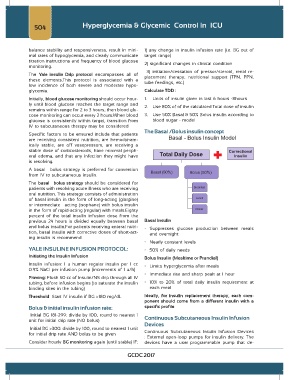
                                                                 The Basal /Bolus insulin concept
              Specific  factors to be  ensured  include that  patients
              are  receiving  consistent  nutrition, are  hemodynam-
              ically  stable, are  off vasopressors,  are  receiving  a
              stable dose of corticosteroids, have minimal periph-
              eral  edema, and that  any infection they might have
              is resolving.
              A  basal – bolus strategy  is  preferred  for  conversion
              from IV to subcutaneous insulin.

              The  basal – bolus strategy should  be  considered  for
              patients with resolving acute illness who are receiving
              oral nutrition. This strategy consists of administration
              of basal insulin in the form of long-acting (glargine)
              or intermediate – acting (isophane) with bolus insulin
              in the form of rapid-acting (regular) with meals.Eighty
              percent  of  the total insulin infusion dose  from  the
              previous  24 hours is  divided equally  between basal   Basal Insulin
              and bolus insulin.For patients receiving enteral nutri-  •  Suppresses  glucose  production between meals
              tion, basal insulin with corrective doses of short-act-  and overnight
              ing insulin is recommend
                                                                 •  Nearly constant levels
              YALE INSULINE INFUSION PROTOCOL:                   •  50% of daily needs
              Initiating the Insulin Infusion                    Bolus Insulin (Mealtime or Prandial)
              Insulin infusion: 1  u human  regular  insulin per  1  cc   •  Limits hyperglycemia after meals
              0.9% NaCl per infusion pump (increments of 1 u/h)
                                                                 •  Immediate rise and sharp peak at 1 hour
              Priming: Flush 50 cc of Insulin/NS drip through all IV
              tubing, before infusion begins (to saturate the insulin   •  10%  to 20%  of total  daily  insulin requirement  at
              binding sites in the tubing)                         each meal
              Threshold: Start IV insulin if BG >180 mg/dL       Ideally, for  insulin  replacement therapy, each  com-
                                                                 ponent should come  from  a  different insulin  with a
              Bolus & initial insulin infusion rate:             specific profile
               Initial BG 181-299: divide by 100, round to nearest 1
              unit for initial drip rate (NO bolus)              Continuous Subcutaneous Insulin Infusion
                                                                 Devices
               Initial BG >300: divide by 100, round to nearest 1 unit
              for initial drip rate AND bolus to be given        Continuous  Subcutaneous  Insulin Infusion Devices
                                                                 : External open-loop  pumps  for  insulin delivery.  The
              Consider hourly BG monitoring again (until stable) IF:   devices have a user  programmable pump that  de-


                                                         GCDC 2017

