


Page 631 - fbkCardioDiabetes_2017
P. 631
Cardio Diabetes Medicine 2017                                   607


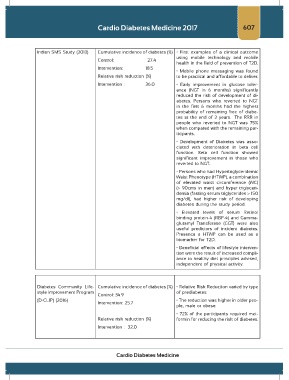
                 Indian SMS Study (2013)    Cumulative incidence of diabetes (%) •  First  examples  of a clinical  outcome
                                                                               using mobile technology and mobile
                                            Control:                     27.4
                                                                               health in the field of prevention of T2D.
                                            Intervention:              18.5
                                                                               •  Mobile  phone  messaging  was  found
                                            Relative risk reduction (%)        to be practical and affordable to deliver.
                                            Intervention :             36.0    •  Early  improvement in glucose toler-
                                                                               ance (NGT  in 6 months)  significantly
                                                                               reduced the risk of development of di-
                                                                               abetes.  Persons  who reverted  to NGT
                                                                               in the first  6 months  had the highest
                                                                               probability  of remaining free  of diabe-
                                                                               tes at  the  end of 2 years.   The RRR  in
                                                                               people  who reverted  to NGT  was 75%
                                                                               when compared with the remaining par-
                                                                               ticipants.
                                                                               •  Development of Diabetes was asso-
                                                                               ciated  with  deterioration in beta  cell
                                                                               function.  Beta cell function showed
                                                                               significant  improvement in those who
                                                                               reverted to NGT.
                                                                               • Persons who had Hypertriglyceridemic
                                                                               Waist Phenotype (HTWP), a combination
                                                                               of elevated waist circumference (WC)
                                                                               (> 90cms  in men)  and hyper  triglyceri-
                                                                               demia (fasting serum triglycerides > 150
                                                                               mg/dl),  had higher  risk  of  developing
                                                                               diabetes during the study period.

                                                                               •  Elevated levels  of  serum  Retinol
                                                                               binding protein-4 (RBP-4)  and Gamma-
                                                                               glutamyl Transferase  (GGT)  were  also
                                                                               useful predictors  of incident diabetes.
                                                                               Presence  a HTWP  can  be used as a
                                                                               biomarker for T2D.
                                                                               • Beneficial effects of lifestyle interven-
                                                                               tion were the result of increased compli-
                                                                               ance to healthy diet principles advised,
                                                                               independent of physical activity.


                 Diabetes Community  Life- Cumulative incidence of diabetes (%) • Relative Risk Reduction varied by type
                 style Improvement Program                                     of prediabetes.
                                            Control: 34.9
                 (D-CLIP) (2016)                                               • The reduction was higher in older peo-
                                            Intervention: 25.7
                                                                               ple, male or obese.
                                                                               •  72% of  the participants  required  met-
                                            Relative risk reduction (%)        formin for reducing the risk of diabetes.
                                            Intervention :  32.0


                                                    Cardio Diabetes Medicine

