


Page 83 - Scientech 2016-17
P. 83
“Cells  can sense the  hydroxyapatite and respond to  its
                                             bioactivity,”  Shah said.  “When you put stem  cells  on our
                                             scaffolds, they turn into bone cells and start to up-regulate
                                           their expression of bone specific genes. This is in the absence
                                        of any other osteo-inducing substances. It’s just the interaction
                                   between the cells and the material itself.”


                                      That’s not to say that other substances couldn’t be combined into
                                       the ink. Because the 3-D printing process is performed at room
                                        temperature, Shah’s team was able to incorporate other elements,
                                         such as antibiotics, into the ink.


                                         “We can incorporate antibiotics  to reduce the possibility  of
                                         infection  after surgery,” Shah said. “We also can combine the
                                        ink with different  types of growth factors,  if  needed, to further
                                       enhance regeneration. It’s really a multi-functional material.”

        One of the biggest advantages, however, is that the end product can be customized to the
        patient. In traditional bone transplant surgeries, the bone -- after it’s taken from another
        part of the body -- has to be shaped and molded to exactly fit the area where it is needed.
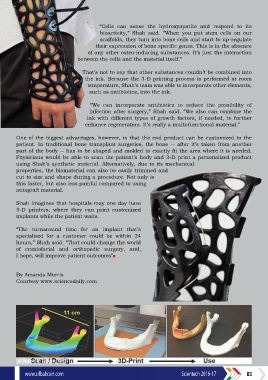
        Physicians would be able to scan the patient’s body and 3-D print a personalized product
        using Shah’s synthetic material. Alternatively, due to its mechanical
        properties, the biomaterial can also be easily trimmed and
        cut to size and shape during a procedure. Not only is
        this faster, but also less painful compared to using
        autograft material.

        Shah imagines that hospitals may one day have
        3-D printers, where they can print customized
        implants while the patient waits.

        “The turnaround time for an implant that’s
        specialized for a customer could be within 24
        hours,” Shah said. “That could change the world
        of  craniofacial  and orthopedic surgery,  and,
        I hope, will improve patient outcomes”


        By Amanda Morris
        Courtesy www.sciencedaily.com


            www.sifbahrain.com                                                    Scientech
-	            83

