


Page 87 - Scientech 2016-17
P. 87
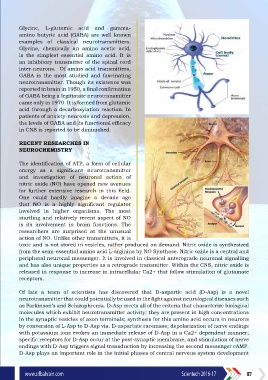
Glycine, L-glutamic acid and gamma-
          amino butyric acid (GABA) are well known
          examples of classical neurotransmitters.
          Glycine,  chemically  an amino acetic acid,
          is the simplest  essential  amino acid. It  is
          an inhibitory transmitter of the spinal cord
          inter-neurons.  Of amino acid transmitters,
          GABA is  the most studied and fascinating
          neurotransmitter. Though its existence was
          reported in brain in 1950, a final confirmation
          of GABA being a legitimate neurotransmitter
          came only in 1970. It is formed from glutamic
          acid through a decarboxylation reaction. In
          patients of anxiety-neurosis and depression,
          the levels of GABA and its functional efficacy
          in CNS is reported to be diminished.


          RECENT RESEARCHES IN
          NEUROCHEMISTRY


          The identification of ATP, a form of cellular
          energy as a significant neurotransmitter
          and investigation  of  neuronal action  of
          nitric oxide (NO) have opened new avenues
          for further extensive research in this field.
          One  could hardly imagine a decade ago
          that NO is a highly significant  regulator
          involved in  higher organisms. The most
          startling and relatively recent aspect of NO
          is  its involvement in brain functions. The
          researchers are  surprised  at  the  unusual
          action of NO. Unlike other transmitters, it is
          toxic and is not stored in vesicles, rather produced on demand. Nitric oxide is synthesized
          from the semi-essential amino acid L-arginine by NO Synthase. Nitric oxide is a central and
          peripheral neuronal messenger. It is involved in classical anterograde neuronal signalling
          and has also unique properties as a retrograde transmitter. Within the CNS, nitric oxide is
          released in response to increase in intracellular Ca2+ that follow stimulation of glutamate
          receptors.


          Of  late  a team  of  scientists  has discovered  that  D-aspartic  acid  (D-Asp)  is  a  novel
          neurotransmitter that could potentially be used in the fight against neurological diseases such
          as Parkinson’s and Schizophrenia. D-Asp meets all of the criteria that characterize biological
          molecules which exhibit neurotransmitter activity: they are present in high concentrations
          in the synaptic vesicles of axon terminals; synthesis for this amino acid occurs in neurons
          by conversion of L-Asp to D-Asp via. D-aspartate racemase; depolarization of nerve endings
          with potassium ions evokes an immediate release of D-Asp in a Ca2+ dependent manner;
          specific receptors for D-Asp occur at the post-synaptic membrane; and stimulation of nerve
          endings with D-Asp triggers signal transduction by increasing the second messenger cAMP.
          D-Asp plays an important role in the initial phases of central nervous system development


            www.sifbahrain.com                                                    Scientech
-	            87

