


Page 33 - 2022-08-01 Sound & Vision
P. 33
exactly the same but compensates    To power the odd-man-out              So, unsurprising to me, during
           for the 6dB increase in input-sensi-  (le  rear) height channel, I used   its unbridged two-channel
           tivity bridging engenders, allowing   one channel of my everyday 7 x    workout, the Primare sounded         At a Glance
           a mix of bridged and unbridged      150-wa  amplifier. For the record, I   indistinguishable from my everyday
           speakers to remain aligned in level.   reverted to regular ol’ unbalanced   amp, a conventional class-A/B      Fault-free sound quality
             Bridging provides the flex-        RCA connections for the surround    design that’s about 6 years old        Flexible, with bridged-
           ibility to accommodate a number     setup—I only have four high-        and also rated to deliver 150 wa s     mode, balanced options
           of different system layouts, with    quality XLR cables.                 into 8 ohms. On even the most
                                                                                                                          As much as 740 watts on
           or without an additional amplifier                                       demanding program material, the        tap in bridged mode
           (such as Primare’s two-channel       PERFORMANCE                        amp effortlessly drove my Energy
           A35.2). Using the A35.8 alone, for                                      2.2 speakers to their useful limits,   High quality fit and finish,
                                                                                                                          quiet Scandinavian looks
           example, you could bridge three     That’s a lot of build-up for what   filling my room with sparkling,
           pairs of outputs to drive the front   is in its essence a very short    dynamic sound. Did the Primare         8 channels (as opposed to
           le , center, and right speakers     report: Primare’s A35.8 is a fully   have an edge in top-volume            7 or 9) not ideal for some
                                                                                                                          home-theater systems
           in a 5.1 system and use the two     transparent, totally competent,     clarity and punch? I think so, but
           remaining outputs to drive the rear   and, depending on the load and    such evaluations are tricky. First,    Expensive
           surround speakers.  For a 5.1.2     configuration, immensely powerful    because A-B comparisons are
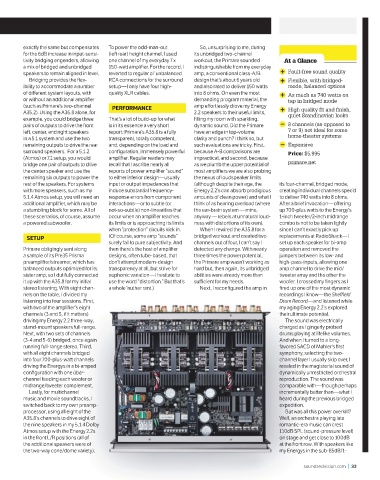
                                                                                                                          Price: $5,995
           (Atmos) or 7.1 setup, you would     amplifier. Regular readers may       impractical, and second, because
                                                                                                                          primare.net
           bridge one pair of outputs to drive   recall that I ascribe nearly all   as we plumb the upper potential of
           the center speaker and use the      reports of power amplifier “sound”   most amplifiers we are also probing
           remaining six outputs to power the   to either inferior design—usually   the nexus of loudspeaker limits
           rest of the speakers. For systems   input or output impedances that     (although despite their age, the   its four-channel, bridged mode,
           with more speakers, such as my      induce substantial frequency-       Energy 2.2’s can absorb prodigious   creating individual channels spec’d
           5.1.4 Atmos setup, you will need an   response errors from component    amounts of clean power) and what I   to deliver 740 wa s into 8 ohms.
           additional amplifier, which may be   interactions—or to subtle (or       think of as hearing overload (where   A er a brief invocation—offering
           a stumbling block for some. All of   not-so-subtle) non-linearities that   the ear-brain system — mine,    up 700-plus wa s to the Energy’s
           these scenarios, of course, assume   occur when an amplifier reaches     anyway — rebels at unnatural loud-  1-inch tweeter/2-inch midrange
           a powered subwoofer.                its limits or is approaching its limits   ness with distortions of its own).   combo is not to be taken lightly
                                               when “protection” circuits kick in.   When I rewired the A35.8 for a   since I can’t exactly pick up
            SETUP                              (Of course, some amp “sounds”       bridged workout and created two    replacements at RadioShack—I
                                               surely fall to pure subjectivity. And   channels out of four, I can’t say I   set up each speaker for bi-amp
           Primare obligingly sent along       then there’s the host of amplifier   detected any change. With nearly   operation and removed the
           a sample of its Pre35 Prisma        designs, o en tube-based, that      three times the power potential,   jumpers between its low- and
           preamplifier/streamer, which has     don’t a empt modern-design          the Primare amp wasn’t working as   high-pass-inputs, allowing one
           balanced outputs optimized for its   transparency at all, but strive for   hard but, then again, its unbridged   amp channel to drive the mid/
           sister amp, so I dutifully connected   euphonic variation—I hesitate to   abilities were already more than   tweeter array and the other the
           it up with the A35.8 for my initial   use the word “distortion.” But that’s   sufficient for my needs.       woofer. I crossed my fingers as I
           stereo listening. With eight chan-  a whole ‘nuther rant.)                Next, I reconfigured the amp in   fired up one of the most dynamic
           nels on the table, I divided my                                                                            recordings I know—the Sheffield
           listening into four sessions. First,                                                                       Drum Record—and listened while
           with two of the amplifier’s eight                                                                           my aging Energy 2.2’s explored
           channels (3 and 5, if it ma ers)                                                                           their ultimate potential.
           driving my Energy 2.2 three-way,                                                                              The sound was electrically
           stand-mount speakers full-range.                                                                           charged as I gingerly probed
           Next, with two sets of channels                                                                            drums playing at lifelike volumes.
           (3-4 and 5-6) bridged, once again                                                                          And when I turned to a long-
           running full-range stereo. Third,                                                                          favored SACD of Mahler’s first
           with all eight channels bridged                                                                            symphony, selecting the two-
           into four 700-plus-wa  channels                                                                            channel layer I usually skip over, I
           driving the Energys in a bi-amped                                                                          reveled in the magisterial sound of
           configuration with one über-                                                                                dynamically unrestricted orchestral
           channel feeding each woofer or                                                                             reproduction. The sound was
           midrange/tweeter complement.                                                                               comparable with—though perhaps
             Lastly, for multichannel                                                                                 incrementally be er than—what I
           music and movie soundtracks, I                                                                             heard during the previous bridged
           switched back to my own preamp-                                                                            expedition.
           processor, using all eight of the                                                                             But was all this power overkill?
           A35.8’s channels to drive eight of                                                                         Well, an orchestra playing late
           the nine speakers in my 5.1.4 Dolby                                                                        romantic-era music can crest
           Atmos setup with the Energy 2.2s                                                                           110dB SPL (sound-pressure level)
           in the front L/R positions (all of                                                                         on stage and get close to 100dB
           the additional speakers were of                                                                            at the front row. With speakers like
           the two-way cone/dome variety).                                                                            my Energys in the sub-85dB/1-

                                                                                                                                                   [
                                                                                                                                 soundandvision.com       33

