


Page 123 - 2022-08-01 Paddling Magazine
P. 123
CREEKERS FOR ALL

                  CREEK BOATS generally make challenging whitewater   way. The stability and predictability of this category
                  more manageable, and that’s true whether you’re crush-  also make creek boats a top choice for some paddlers
                  ing class V or a beginner looking to step up to class III.   on difficult, high-volume whitewater. Those same
                    The term creek boat is an allusion to creeking—  attributes are also valuable for helping beginner and
                  paddling steep, low-volume whitewater. Modern creek   intermediate paddlers feel confident and step up
                  boats typically have high-volume designs, displace-  their game. Finally, a creek boat’s higher volume and
                  ment hulls and rounded ends to charge downriver   relatively larger size also make it an ideal kayak for
                  and not get hung up in or on river features on the   carrying gear on multiday river trips.


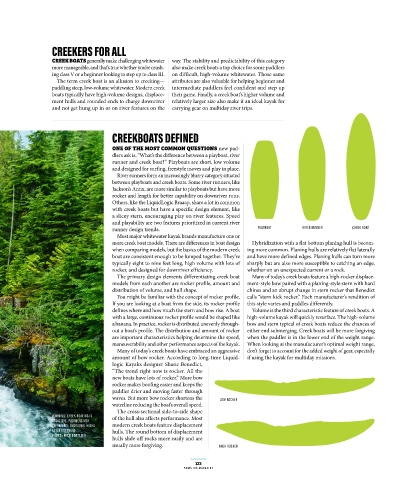
                                      CREEKBOATS DEFINED


                                      ONE OF THE MOST COMMON QUESTIONS new pad-
                                      dlers ask is, “What’s the difference between a playboat, river
                                      runner and creek boat?” Playboats are short, low volume
                                      and designed for surfing, freestyle moves and play in place.
                                       River runners form an increasingly blurry category situated
                                      between playboats and creek boats. Some river runners, like
                                      Jackson’s Antix, are more similar to playboats but have more
                                      rocker and length for better capability on downriver runs.
                                      Others, like the LiquidLogic Braaap, share a lot in common
                                      with creek boats but have a specific design element, like
                                      a slicey stern, encouraging play on river features. Speed
                                      and playability are two features prioritized in current river
                                      runner design trends.                          PLAYBOAT       RIVER RUNNER    CREEK BOAT
                                       Most major whitewater kayak brands manufacture one or
                                      more creek boat models. There are differences in boat design   Hybridization with a flat bottom planing hull is becom-
                                      when comparing models, but the basics of the modern creek   ing more common. Planing hulls are relatively flat laterally
                                      boat are consistent enough to be lumped together. They’re   and have more defined edges. Planing hulls can turn more
                                      typically eight to nine feet long, high volume with lots of   sharply but are also more susceptible to catching an edge,
                                      rocker, and designed for downriver efficiency.  whether on an unexpected current or a rock.
                                       The primary design elements differentiating creek boat   Many of today’s creek boats feature a high-rocker displace-
                                      models from each another are rocker profile, amount and   ment-style bow paired with a planing-style stern with hard
                                      distribution of volume, and hull shape.     chines and an abrupt change in stern rocker that Benedict
                                       You might be familiar with the concept of rocker profile.   calls “stern kick rocker.” Each manufacturer’s rendition of
                                      If you are looking at a boat from the side, its rocker profile   this style varies and paddles differently.
                                      defines where and how much the stern and bow rise. A boat   Volume is the third characteristic feature of creek boats. A
                                      with a large, continuous rocker profile would be shaped like   high-volume kayak will quickly resurface. The high-volume
                                      a banana. In practice, rocker is distributed unevenly through-  bow and stern typical of creek boats reduce the chances of
                                      out a boat’s profile. The distribution and amount of rocker   either end submerging. Creek boats will be more forgiving
                                      are important characteristics helping determine the speed,   when the paddler is in the lower end of the weight range.
                                      maneuverability and other performance aspects of the kayak.   When looking at the manufacturer’s optimal weight range,
                                       Many of today’s creek boats have embraced an aggressive   don’t forget to account for the added weight of gear, especially
                                      amount of bow rocker. According to long-time Liquid-  if using the kayak for multiday missions.
                                      logic Kayaks designer Shane Benedict,
                                      “The trend right now is rocker. All the
                                      new boats have lots of rocker.” More bow
                                      rocker makes boofing easier and keeps the
                                      paddler drier and moving faster through
                                      waves. But more bow rocker shortens the   LOW ROCKER
                                      waterline reducing the boat’s overall speed.
                                       The cross-sectional side-to-side shape
                  WARNING: CREEK BOATING IS   of the hull also affects performance. Most
                  ADDICTIVE. PADDLERS MAY
                  EXPERIENCE EMOTIONAL HIGHS   modern creek boats feature displacement
                  AFTER EXPOSURE.     hulls. The round bottom of displacement
                  PHOTO: NICK GOTTLIEB
                                      hulls slide off rocks more easily and are
                                      usually more forgiving.            HIGH ROCKER


                                                                 123
                                                             P A D D L IN G  M A G A Z IN E

