


Page 124 - 2022-08-01 Paddling Magazine
P. 124
WHITEWATER
                                                                                                   PHOTO: NICK GOTTLIEB


        WHAT’S INSIDE

        MOST CREEK BOATS, like the rest   safety, or more adjustable to fit as many   In terms of safety, modern creek
        of whitewater kayaks, are made from   people as quickly as possible.  boats from reputable brands come with   USED CREEK BOAT
        rotomolded high-density polyethylene.   If you’re considering multiday trips,   two bow and three stern grab handles.   BUYING TIPS
        Polyethylene is a resilient plastic suited   it’s important to be able to pack gear into   Most are metal, reinforced, angled and   Kayaks can last decades, so
        for the abuse creek boats suffer on river   the boat easily. The boat’s outfitting con-  shaped to clip into easily. Safety step-  there’s no reason not to consider
        rocks. To make the kayak, plastic pellets   tributes to this in a few ways. First, some   out pillars are a reasonably new idea   buying used. That said, used
        are poured into a hollow metal mold   creek boats allow you to remove the   replacing minicell foam pillars in the   kayaks come in all sorts of condi-
        and then heated and rotated in a mas-  bulkhead easily and pack gear in front   bow. Two things here: The boat is less   tions. Of course, you want to be
        sive oven to distribute the now-molten   of it. This is a great feature, but it’s not a   likely to crush and trap your legs; and,   sure you’re paying a reasonable
        plastic throughout the mold. The trick   dealbreaker—many people self-support   if pinned, you can step on them and   price for the number of days
        is to get the right amount of plastic to   without packing gear in front.  step out of the boat.   you’re likely to get out of the boat.
        be crazy durable but not stupid heavy.   Access behind the seat varies from   Creek boats have bulkheads, not foot   Try to ascertain how much
        After it has cooled, the mold is removed   boat to boat, too. While it’s good   pegs. It’s a good practice to cover the   the person selling the boat has
        to reveal a perfectly cast kayak requiring   enough in virtually all creek boats,   bulkhead with minicell foam to cushion   paddled it and on what kind
        only light hand-finishing for outfitting   some models and designs will be easier   your ankles from impact and prevent   of whitewater. If you’re buying
        and accessories.              to work with. Ultimately, it depends on   your feet from slipping past the edges   a pro paddler’s year-old creek
          Speaking of accessories, comfort   the hardware at the back of the seat, and   of the bulkhead and getting trapped.   boat, the odds are good they’ve
        matters. Creek boating is not like   the space between the seat and the top   Some kayaks ship with this pre-in-  used and abused it and even if
        playboating at a local surf spot where   of the hull behind the cockpit. Either   stalled foam, other manufacturers   it isn’t cracked, it might be close.
        you’re typically taking a few rides and   test your gear to see if it will fit or be   provide adjustable foam blocks to glue   When I lived on the East Coast,
        then getting out for a break. If you’re   prepared to change your packing list   to your bulkhead. Dagger’s bulkheads,   paddling 150 to 200 days a year,
        paddling a creek boat, you’ll likely be   and system to suit your new boat.  for example, can be adjusted to fit the   I would break about one boat
        in it a decent amount of time, especially   No kayak outfitting is more robust   hull’s shape and come with pre-marked   a year, regardless of brand. If
        on longer trips or multiday expeditions.   than creek boat outfitting. Things we’ve   foam pads. If your boat doesn’t come   a boat has been paddled con-
        Today’s boaters are lucky. Outfitting   learned about durability and safety have   with foam on the bulkhead, consider   sistently on hard, lower volume
        has never been better for comfort and   been filtering down into river runners.   buying some and adding it yourself.  whitewater, odds are it’s near its
                                                                                                   breaking point.
                                                                                                     You can also assess this by
                                                                                                   looking at the boat. Is there oil
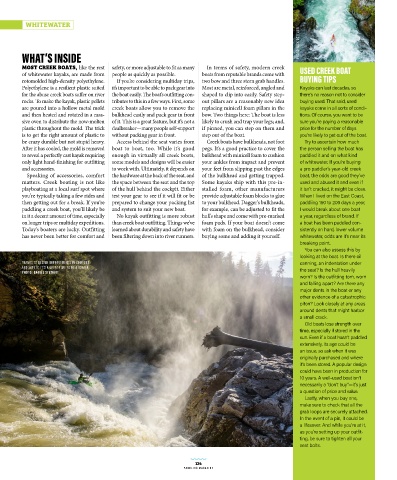
        THANKS TO DESIGN IMPROVEMENTS IN COMFORT                                                   canning, an indentation under
        AND SAFETY, IT'S A GREAT TIME TO BE A BOATER.                                              the seat? Is the hull heavily
        PHOTO: DANIEL STEWART
                                                                                                   worn? Is the outfitting torn, worn
                                                                                                   and falling apart? Are there any
                                                                                                   major dents in the boat or any
                                                                                                   other evidence of a catastrophic
                                                                                                   piton? Look closely at any areas
                                                                                                   around dents that might harbor
                                                                                                   a small crack.
                                                                                                     Old boats lose strength over
                                                                                                   time, especially if stored in the
                                                                                                   sun. Even if a boat hasn’t paddled
                                                                                                   extensively, its age could be
                                                                                                   an issue, so ask when it was
                                                                                                   originally purchased and where
                                                                                                   it’s been stored. A popular design
                                                                                                   could have been in production for
                                                                                                   10 years. A well-used boat isn’t
                                                                                                   necessarily a “don’t buy”—it’s just
                                                                                                   a question of price and value.
                                                                                                     Lastly, when you buy one,
                                                                                                   make sure to check that all the
                                                                                                   grab loops are securely attached.
                                                                                                   In the event of a pin, it could be
                                                                                                   a lifesaver. And while you’re at it,
                                                                                                   as you’re setting up your outfit-
                                                                                                   ting, be sure to tighten all your
                                                                                                   seat bolts.


                                                                 124
                                                             P A D D L IN G  M A G A Z IN E

