


Page 52 - 2016 Handbook FINAL 4.18.16
P. 52
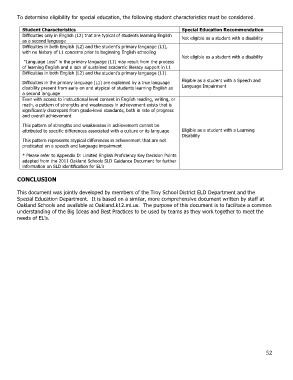
To determine eligibility for special education, the following student characteristics must be considered.

          Student Characteristics                                            Special Education Recommendation
          Difficulties only in English (L2) that are typical of students learning English   Not eligible as a student with a disability
          as a second language
          Difficulties in both English (L2) and the student’s primary language (L1),
          with no history of L1 concerns prior to beginning English schooling
                                                                             Not eligible as a student with a disability
           “Language Loss” in the primary language (L1) may result from the process
          of learning English and a lack of sustained academic literacy support in L1
          Difficulties in both English (L2) and the student’s primary language (L1)

          Difficulties in the primary language (L1) are explained by a true language   Eligible as a student with a Speech and
          disability present from early on and atypical of students learning English as   Language Impairment
          a second language
          Even with access to instructional level content in English reading, writing, or
          math, a pattern of strengths and weaknesses in achievement exists that is
          significantly discrepant from grade-level standards, both in rate of progress
          and overall achievement

          This pattern of strengths and weaknesses in achievement cannot be
          attributed to specific differences associated with a culture or its language    Eligible as a student with a Learning
                                                                             Disability
          This pattern represents atypical differences in achievement that are not
          predicated on a speech and language impairment

          * Please refer to Appendix D: Limited English Proficiency Key Decision Points
          adapted from the 2011 Oakland Schools SLD Guidance Document for further
          information on SLD identification for EL’s

        CONCLUSION

        This document was jointly developed by members of the Troy School District ELD Department and the
        Special Education Department.  It is based on a similar, more comprehensive document written by staff at
        Oakland Schools and available at Oakland.k12.mi.us.  The purpose of this document is to facilitate a common
        understanding of the Big Ideas and Best Practices to be used by teams as they work together to meet the
        needs of EL’s.


                                                                                                                52

