


Page 25 - BoAML Plan Handbook 17 V2.0
P. 25
Freestyle


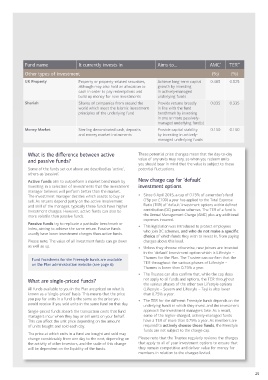
 The Freestyle funds are summarised below.
 The name of each fund describes the asset class in which it invests, or the principles on which it is based. It means that the Trustee   *   **
 can monitor and manage the funds, and make any necessary changes (if the Trustee considers that changes are appropriate) quickly   Fund name  It currently invests in  Aims to…  AMC  TER
 and efficiently. See page 26 to read more about the different asset classes.  Other types of investment  (%)  (%)

            UK Property             Property or property-related securities,   Achieve long-term capital   0.485  0.525
 Fund name  It currently invests in  Aims to…  AMC *   TER **  although may also hold an allocation to   growth by investing
 Equities (active)  (%)  (%)        cash in order to pay redemptions and    in actively-managed
                                    build up money for new investments  underlying funds
 Emerging Markets Equity  Shares of companies in countries,   Achieve long-term capital   0.835  0.970  Shariah  Shares of companies from around the   Provide returns broadly   0.035  0.335
 designated as emerging markets  growth by investing   world which meet the Islamic investment   in line with the fund
 Global Equity  Shares of companies around the world  in actively-managed   0.622  0.699  principles of the underlying fund  benchmark by investing
 UK Equity  Shares of companies in the UK  underlying funds   0.477  0.603  in one or more passively-
                                                                       managed underlying fund(s)
 Diversified assets  (%)  (%)
            Money Market            Sterling denominated cash, deposits    Provide capital stability    0.150  0.150
 A range of asset classes including equities,   Achieve long-term capital   0.635  0.683  and money market instruments  by investing in actively-
 bonds, property, commodities, hedge    growth by investing            managed underlying funds
 Diversified Growth
 funds, derivatives and cash/currencies    in actively-managed
 around the world  underlying funds
             What is the difference between active             These potential price changes mean that the day-to-day
 Equities (passive)   (%)  (%)                                 value of any units may vary, so when you redeem units
             and passive funds?
 Asia Pacific (ex-Japan) Equity Shares of companies in the Asia Pacific   0.085  0.099  you should bear in mind that the value is subject to these
 region excluding Japan  Some of the funds set out above are described as ‘active’,   potential fluctuations.
             others as ‘passive’.
 Ethical Global Equity  Shares of companies that are selected   0.335  0.335
 based on the socially responsible investing   Active funds aim to outperform a market benchmark by   New charge cap for ‘default’
 (SRI) criteria of the underlying funds  Provide positive returns in   investing in a selection of investments that the investment   investment options
 European (ex-UK) Equity  Shares of companies in Europe (ex-UK)  all market conditions, over   0.085  0.100  manager believes will perform better than the market.    •  Since 6 April 2015, a cap of 0.75% of a member’s fund
 the medium to long term  The investment manager decides which assets to buy or
 Japanese Equity  Shares of companies in Japan  0.085  0.096  sell. As returns depend partly on the active involvement   (75p per £100) a year has applied to the Total Expense
 North American Equity  Shares of companies in North America  0.085  0.093  and skill of the manager, typically these funds have higher   Ratio (TER) of ‘default’ investment options within defined
             investment charges. However, active funds can also be   contribution (DC) pension schemes. The TER of a fund is
 UK Equity  Shares of companies in the UK  0.085  0.089          the Annual Management Charge (AMC) plus any additional
             more volatile than passive funds.
 World (ex-UK) Equity  Shares of companies around the world (ex-UK)  0.085  0.095  expenses incurred.
             Passive funds try to replicate a particular benchmark or
 Bonds and gilts   (%)  (%)  index, aiming to achieve the same return. Passive funds   •  This legislation was introduced to protect employees
             usually have lower investment charges than active funds.  who join DC schemes, and who do not make a specific
 Gilts   UK government bonds with a maturity   0.085  0.089      choice of which funds they wish to invest in, from paying
 period of 15 years or longer  Please note: The value of all investment funds can go down    charges above this level.
 Index-Linked Gilts   Index-linked UK government bonds with    0.085  0.089  as well as up.  •  Unless they choose otherwise, new joiners are invested
 a maturity period of five years or longer                       in the ‘default’ investment option which is Lifestyle –
 UK Corporate Bond – Active Investment grade corporate bonds   Provide positive returns in   0.305  0.315  Fund factsheets for the Freestyle funds are available   Thames for the Plan. The Trustee can confirm that the
 denominated in Sterling of all durations –   all market conditions, over   on the Plan administration website (see page 6).  TER throughout the various phases of Lifestyle –
 actively managed  the medium to long term                       Thames is lower than 0.75% a year.
 UK Corporate Bond –   Investment grade corporate bonds   0.085  0.100  •  The Trustee can also confirm that, while the cap does
 Passive (previously known   denominated in Sterling of all durations –   What are single-priced funds?  not apply to all funds and options, the TER throughout
 as UK Corporate Bond)  passively managed                        the various phases of the other two Lifestyle options
             All funds available to you in the Plan are priced on what is   (Lifestyle – Severn and Lifestyle – Tay) is also lower
 Pre-Retirement  UK government and corporate bonds   0.178  0.178  known as a ‘single-priced’ basis. This means that the price   than 0.75% a year.
             you pay for units in a fund is the same as the price you   •  The TER for the different Freestyle funds depends on the
    * Annual Management Charge (AMC) is the annual fee charged by the investment manager. The AMCs shown above are correct as at    would receive if you sold units in the same fund on that day.   underlying funds in which they invest and the investment
 31 December 2016 and are subject to change. AMCs for the active equity and diversified funds will fluctuate slightly with changes    approach the investment managers take. As a result,
 in the mix of the underlying funds.  Single-priced funds absorb the transaction costs that fund
             managers incur when they buy or sell units on your behalf.   some of the higher-charged, actively-managed funds
 **  Total Expense Ratio (TER) is the total cost of investing in the fund. It is automatically deducted from the price of the funds in which    have a TER of more than 0.75% a year. As members are
 you are invested. The TER includes the AMC and any other additional fund expenses such as trading fees, legal fees, auditor fees and    This can affect the unit price depending on the amount
 other operational expenses. The TERs shown above are correct as at 31 December 2016 and are subject to change.  of units bought and sold each day.  required to actively choose these funds, the Freestyle
                                                                 funds are not subject to the charge cap.
             The price at which units in a fund are bought and sold may
             change considerably from one day to the next, depending on   Please note that the Trustee regularly reviews the charges
             the activity of other investors, and the scale of this change   that apply to all of your investment options to ensure that
             will be dependent on the liquidity of the funds.   they remain competitive and deliver value for money for
                                                               members in relation to the charges levied.


 24                                                                                                               25

