


Page 176 - English Class 9
P. 176
II

            The Maya civilisation was one of the most dominant indigenous societies of
            Mesoamerica, present Mexico and Central America. Unlike other scattered
            indigenous populations of Mesoamerica, the Maya were centered in one
            geographical block covering all of the Yucatan Peninsula and modern-day
            Guatemala; Belize and parts of the Mexican states of Tabasco and Chiapas;
            and the western part of Honduras and El Salvador. This concentration
            showed that the Maya remained relatively secure from invasion by other
            Mesoamerican peoples.
                                 Curriculum Development Centre 78-CEHRD
                                         III
            The Maya lived in three  separate
            sub-areas with distinct environmental
            and cultural differences: the northern
            Maya lowlands on the Yucatan
            Peninsula; the southern lowlands
            in the Petén district of northern
            Guatemala and adjacent portions
            of Mexico, Belize and western
            Honduras; and the southern Maya highlands, in the mountainous region                                                       Curriculum Development Centre 78-CEHRD
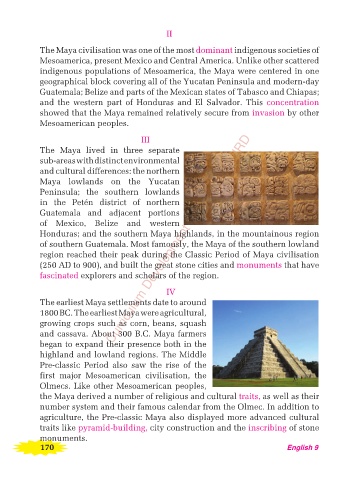
            of southern Guatemala. Most famously, the Maya of the southern lowland
            region reached their peak during the Classic Period of Maya civilisation
            (250 AD to 900), and built the great stone cities and monuments that have
            fascinated explorers and scholars of the region.

                                                IV
            The earliest Maya settlements date to around
            1800 BC. The earliest Maya were agricultural,
            growing crops such as corn, beans, squash
            and cassava. About 300 B.C. Maya farmers
            began to expand their presence both in the
            highland and lowland regions. The Middle
            Pre-classic  Period  also saw the  rise  of the
            first major Mesoamerican civilisation, the
            Olmecs. Like other Mesoamerican peoples,
            the Maya derived a number of religious and cultural traits, as well as their
            number system and their famous calendar from the Olmec. In addition to
            agriculture, the Pre-classic Maya also displayed more advanced cultural
            traits like pyramid-building, city construction and the inscribing of stone
            monuments.
            170                                                                      English 9

