


Page 177 - English Class 9
P. 177
V
            The Classic Period, which began around 250 AD, was the golden age of
            the Maya Empire. Classic Maya civilisation grew to some 40 cities. Each
            city held a population of between 5,000 and 50,000 people. At its peak, the
            Maya population may have reached 2,000,000. Excavations of Maya sites
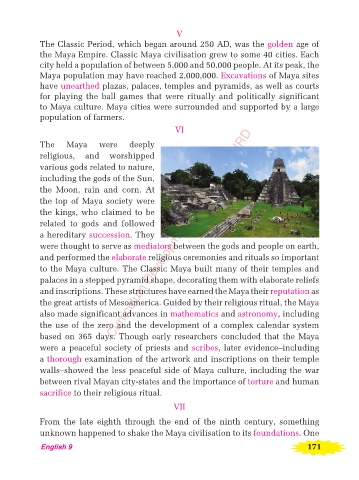
            have unearthed plazas, palaces, temples and pyramids, as well as courts
            for playing the ball games that were  ritually and politically significant
            to Maya culture. Maya cities were surrounded and supported by a large
            population of farmers.
                                                   VI
                                 Curriculum Development Centre 78-CEHRD
 Curriculum Development Centre 78-CEHRD
            The     Maya     were     deeply
            religious, and  worshipped
            various gods related to nature,
            including the gods of the Sun,
            the Moon, rain and corn. At
            the top of Maya society were
            the kings, who claimed to be
            related to gods and  followed
            a hereditary succession. They
            were thought to serve as mediators between the gods and people on earth,
            and performed the elaborate religious ceremonies and rituals so important
            to the Maya culture. The Classic Maya built many of their temples and
            palaces in a stepped pyramid shape, decorating them with elaborate reliefs
            and inscriptions. These structures have earned the Maya their reputation as
            the great artists of Mesoamerica. Guided by their religious ritual, the Maya
            also made significant advances in mathematics and astronomy, including
            the use of the zero and the development of a complex calendar system
            based on 365 days. Though early researchers concluded that the Maya
            were a peaceful society of priests and scribes, later evidence–including
            a thorough examination of the artwork and inscriptions on their temple
            walls–showed the less peaceful side of Maya culture, including the war
            between rival Mayan city-states and the importance of torture and human
            sacrifice to their religious ritual.
                                                  VII

            From the late eighth through the end of the ninth century,  something
            unknown happened to shake the Maya civilisation to its foundations. One
             English 9                                                                  171

