


Page 184 - English Class 9
P. 184
Reading II

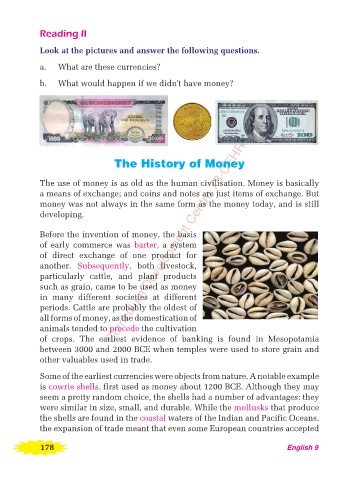
            Look at the pictures and answer the following questions.

            a.   What are these currencies?

            b.   What would happen if we didn't have money?


                                 Curriculum Development Centre 78-CEHRD


                                 The History of Money


            The use of money is as old as the human civilisation. Money is basically
            a means of exchange; and coins and notes are just items of exchange. But
            money was not always in the same form as the money today, and is still
            developing.


            Before the invention of money, the basis                                                                                   Curriculum Development Centre 78-CEHRD
            of early commerce  was  barter, a system
            of direct exchange of one product for
            another.  Subsequently, both livestock,
            particularly cattle, and  plant  products
            such as grain, came to be used as money
            in many different societies at different
            periods. Cattle are probably the oldest of
            all forms of money, as the domestication of
            animals tended to precede the cultivation
            of crops. The earliest  evidence  of banking is found in Mesopotamia
            between 3000 and 2000 BCE when temples were used to store grain and
            other valuables used in trade.

            Some of the earliest currencies were objects from nature. A notable example
            is cowrie shells, first used as money about 1200 BCE. Although they may
            seem a pretty random choice, the shells had a number of advantages: they
            were similar in size, small, and durable. While the mollusks that produce
            the shells are found in the coastal waters of the Indian and Pacific Oceans,
            the expansion of trade meant that even some European countries accepted

            178                                                                      English 9

