


Page 185 - English Class 9
P. 185
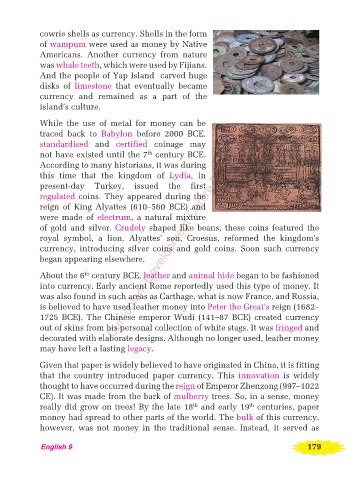
cowrie shells as currency. Shells in the form
            of wampum were used as money by Native
            Americans.  Another  currency  from  nature
            was whale teeth, which were used by Fijians.
            And the people of Yap Island  carved huge
            disks of  limestone that eventually became
            currency  and remained as a part of the
            island’s culture.

            While the  use of metal  for  money can  be
                                 Curriculum Development Centre 78-CEHRD
            traced  back to  Babylon  before  2000  BCE,
 Curriculum Development Centre 78-CEHRD
            standardised  and  certified  coinage may
                                           th
            not have existed until the 7  century BCE.
            According to many historians, it was during
            this  time that the kingdom  of  Lydia,  in
            present-day Turkey, issued the first
            regulated coins. They appeared during the
            reign of King  Alyattes  (610–560  BCE) and
            were made of  electrum,  a natural mixture
            of gold and silver. Crudely shaped like beans, these coins featured the
            royal symbol, a lion.  Alyattes’ son,  Croesus, reformed the kingdom’s
            currency,  introducing silver coins and gold coins. Soon such currency
            began appearing elsewhere.

            About the 6  century BCE, leather and animal hide began to be fashioned
                         th
            into currency. Early ancient Rome reportedly used this type of money. It
            was also found in such areas as Carthage, what is now France, and Russia,
            is believed to have used leather money into Peter the Great’s reign (1682–
            1725 BCE). The Chinese emperor Wudi (141–87 BCE) created currency
            out of skins from his personal collection of white stags. It was fringed and
            decorated with elaborate designs. Although no longer used, leather money
            may have left a lasting legacy.

            Given that paper is widely believed to have originated in China, it is fitting
            that the country introduced paper currency.  This  innovation is widely
            thought to have occurred during the reign of Emperor Zhenzong (997–1022
            CE). It was made from the bark of mulberry trees. So, in a sense, money
            really did grow on trees! By the late 18  and early 19  centuries, paper
                                                        th
                                                                        th
            money had spread to other parts of the world. The bulk of this currency,
            however, was not money in the traditional sense. Instead, it served as

             English 9                                                                  179

