


Page 217 - English Class 9
P. 217
In the wake of Hurricane Sandy, the power and  unpredictability of
            nature and the ever-changing weather patterns have become increasingly
            apparent. As topics such as weather  and global warming become
            increasingly  prevalent in today’s culture,  James Balog’s documentary
            Chasing Ice provides striking images of how climate change has caused
            glacial erosion.

            The award-winning  movie which  opens in  Los Angeles on  Nov. 23,
            traces the journey of environmental photographer Balog as he attempts
            to capture the erosion of glaciers in the Arctic through photographs and
            video. In order to accomplish this goal, Balog started his own project and
            dubbed it in the Extreme Ice Survey. This endeavor began as a project for
            National Geographic and turned out to reach a broader scope by tackling
            the problem of glacial erosion.

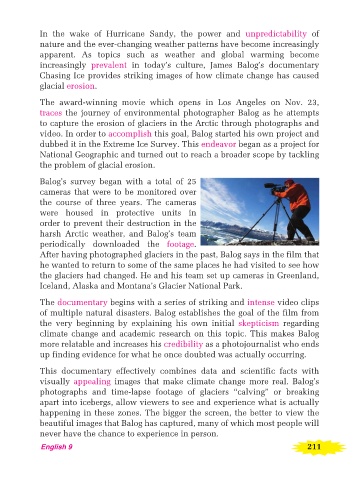
            Balog’s survey began with a total of 25
            cameras that were to be monitored over
            the course of three  years. The cameras
            were  housed in protective  units in
            order to prevent their destruction in the
            harsh Arctic  weather,  and Balog’s team
            periodically downloaded the  footage.
            After having photographed glaciers in the past, Balog says in the film that
            he wanted to return to some of the same places he had visited to see how
            the glaciers had changed. He and his team set up cameras in Greenland,
            Iceland, Alaska and Montana’s Glacier National Park.

            The documentary begins with a series of striking and intense video clips
            of multiple natural disasters. Balog establishes the goal of the film from
            the very  beginning  by explaining his own initial  skepticism regarding
            climate change and academic research on this topic. This makes Balog
            more relatable and increases his credibility as a photojournalist who ends
            up finding evidence for what he once doubted was actually occurring.

            This documentary  effectively  combines data and scientific  facts  with
            visually  appealing images  that  make climate  change  more  real.  Balog’s
            photographs and time-lapse footage  of glaciers  “calving”  or breaking
            apart into icebergs, allow viewers to see and experience what is actually
            happening in these zones. The bigger the screen, the better to view the
            beautiful images that Balog has captured, many of which most people will
            never have the chance to experience in person.
             English 9                                                                  211

