


Page 232 - English Class 9
P. 232
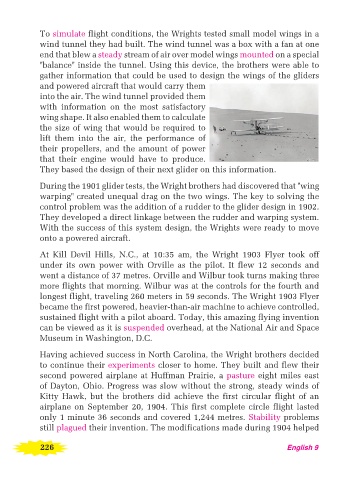
To simulate flight conditions, the Wrights tested small model wings in a
            wind tunnel they had built. The wind tunnel was a box with a fan at one
            end that blew a steady stream of air over model wings mounted on a special
            "balance" inside the tunnel. Using this device, the brothers were able to
            gather information that could be used to design the wings of the gliders
            and powered aircraft that would carry them
            into the air. The wind tunnel provided them
            with information on the most satisfactory
            wing shape. It also enabled them to calculate
            the size of wing that would be required to
            lift them into the air, the performance  of
            their propellers, and the amount of power
            that their engine would have to produce.
            They based the design of their next glider on this information.

            During the 1901 glider tests, the Wright brothers had discovered that "wing
            warping" created unequal drag on the two wings. The key to solving the
            control problem was the addition of a rudder to the glider design in 1902.
            They developed a direct linkage between the rudder and warping system.
            With the success of this system design, the Wrights were ready to move
            onto a powered aircraft.

            At Kill  Devil Hills,  N.C.,  at 10:35  am, the Wright 1903  Flyer took off
            under its own power with Orville as the pilot. It flew 12  seconds and
            went a distance of 37 metres. Orville and Wilbur took turns making three
            more flights that morning. Wilbur was at the controls for the fourth and
            longest flight, traveling 260 meters in 59 seconds. The Wright 1903 Flyer
            became the first powered, heavier-than-air machine to achieve controlled,
            sustained flight with a pilot aboard. Today, this amazing flying invention
            can be viewed as it is suspended overhead, at the National Air and Space
            Museum in Washington, D.C.

            Having achieved success in North Carolina, the Wright brothers decided
            to continue their experiments closer to home. They built and flew their
            second powered airplane at Huffman Prairie, a pasture eight miles east
            of Dayton, Ohio. Progress was slow without the strong, steady winds of
            Kitty Hawk, but the brothers  did achieve  the first circular  flight of an
            airplane on September 20, 1904. This first complete circle flight lasted
            only 1 minute 36 seconds and covered 1,244 metres. Stability problems
            still plagued their invention. The modifications made during 1904 helped

            226                                                                      English 9

