


Page 122 - A Mind For Numbers: How to Excel at Math and Science
P. 122
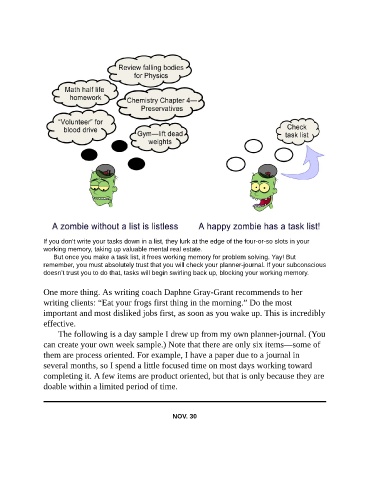
If you don’t write your tasks down in a list, they lurk at the edge of the four-or-so slots in your
               working memory, taking up valuable mental real estate.
                   But once you make a task list, it frees working memory for problem solving. Yay! But
               remember, you must absolutely trust that you will check your planner-journal. If your subconscious
               doesn’t trust you to do that, tasks will begin swirling back up, blocking your working memory.


               One more thing. As writing coach Daphne Gray-Grant recommends to her
               writing clients: “Eat your frogs first thing in the morning.” Do the most
               important and most disliked jobs first, as soon as you wake up. This is incredibly
               effective.
                    The following is a day sample I drew up from my own planner-journal. (You
               can create your own week sample.) Note that there are only six items—some of
               them are process oriented. For example, I have a paper due to a journal in

               several months, so I spend a little focused time on most days working toward
               completing it. A few items are product oriented, but that is only because they are
               doable within a limited period of time.


                                                          NOV. 30

