


Page 130 - A Mind For Numbers: How to Excel at Math and Science
P. 130
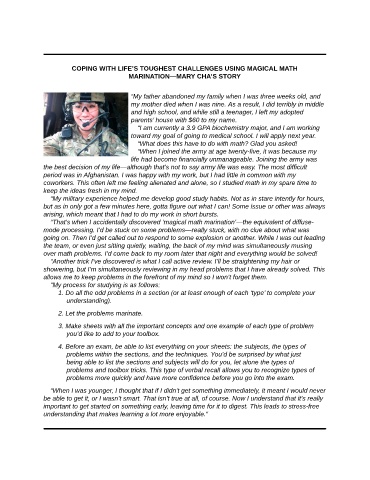
COPING WITH LIFE’S TOUGHEST CHALLENGES USING MAGICAL MATH
                                            MARINATION—MARY CHA’S STORY


                                            “My father abandoned my family when I was three weeks old, and
                                            my mother died when I was nine. As a result, I did terribly in middle
                                            and high school, and while still a teenager, I left my adopted
                                            parents’ house with $60 to my name.
                                               “I am currently a 3.9 GPA biochemistry major, and I am working
                                            toward my goal of going to medical school. I will apply next year.
                                               “What does this have to do with math? Glad you asked!
                                               “When I joined the army at age twenty-five, it was because my
                                            life had become financially unmanageable. Joining the army was
               the best decision of my life—although that’s not to say army life was easy. The most difficult
               period was in Afghanistan. I was happy with my work, but I had little in common with my
               coworkers. This often left me feeling alienated and alone, so I studied math in my spare time to
               keep the ideas fresh in my mind.
                  “My military experience helped me develop good study habits. Not as in stare intently for hours,
               but as in only got a few minutes here, gotta figure out what I can! Some issue or other was always
               arising, which meant that I had to do my work in short bursts.
                  “That’s when I accidentally discovered ‘magical math marination’—the equivalent of diffuse-
               mode processing. I’d be stuck on some problems—really stuck, with no clue about what was
               going on. Then I’d get called out to respond to some explosion or another. While I was out leading
               the team, or even just sitting quietly, waiting, the back of my mind was simultaneously musing
               over math problems. I’d come back to my room later that night and everything would be solved!
                  “Another trick I’ve discovered is what I call active review. I’ll be straightening my hair or
               showering, but I’m simultaneously reviewing in my head problems that I have already solved. This
               allows me to keep problems in the forefront of my mind so I won’t forget them.
                  “My process for studying is as follows:
                    1. Do all the odd problems in a section (or at least enough of each ‘type’ to complete your
                       understanding).
                    2. Let the problems marinate.

                    3. Make sheets with all the important concepts and one example of each type of problem
                       you’d like to add to your toolbox.

                    4. Before an exam, be able to list everything on your sheets: the subjects, the types of
                       problems within the sections, and the techniques. You’d be surprised by what just
                       being able to list the sections and subjects will do for you, let alone the types of
                       problems and toolbox tricks. This type of verbal recall allows you to recognize types of
                       problems more quickly and have more confidence before you go into the exam.

                  “When I was younger, I thought that if I didn’t get something immediately, it meant I would never
               be able to get it, or I wasn’t smart. That isn’t true at all, of course. Now I understand that it’s really
               important to get started on something early, leaving time for it to digest. This leads to stress-free
               understanding that makes learning a lot more enjoyable.”

