


Page 175 - A Mind For Numbers: How to Excel at Math and Science
P. 175
takes on a new life in our own minds—we form ideas that enhance and enlighten
               the neural patterns we already possess, allowing us to more readily see and
               develop other related patterns.
                    Once we have created a chunk as a neural pattern, we can more easily pass
               that chunked pattern to others, as Cajal and other great artists, poets, scientists,
               and writers have done for millennia. Once other people grasp that chunk, not
               only can they use it, but also they can more easily create similar chunks that

               apply to other areas in their lives—an important part of the creative process.


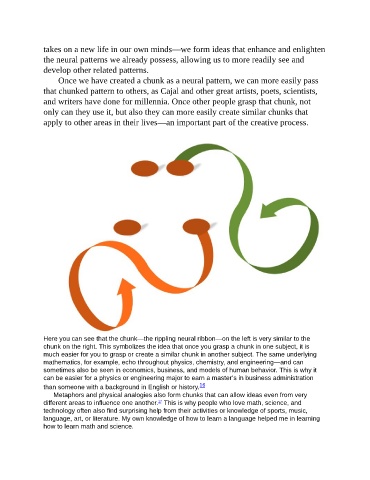
               Here you can see that the chunk—the rippling neural ribbon—on the left is very similar to the
               chunk on the right. This symbolizes the idea that once you grasp a chunk in one subject, it is
               much easier for you to grasp or create a similar chunk in another subject. The same underlying
               mathematics, for example, echo throughout physics, chemistry, and engineering—and can
               sometimes also be seen in economics, business, and models of human behavior. This is why it
               can be easier for a physics or engineering major to earn a master’s in business administration
               than someone with a background in English or history. 16
                   Metaphors and physical analogies also form chunks that can allow ideas even from very
               different areas to influence one another.  This is why people who love math, science, and
                                                     17
               technology often also find surprising help from their activities or knowledge of sports, music,
               language, art, or literature. My own knowledge of how to learn a language helped me in learning
               how to learn math and science.

