


Page 172 - A Mind For Numbers: How to Excel at Math and Science
P. 172
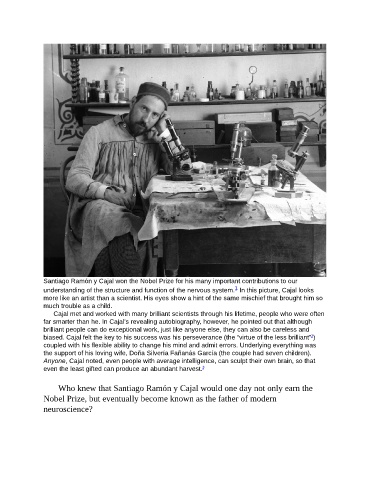
Santiago Ramón y Cajal won the Nobel Prize for his many important contributions to our
                                                                               1
               understanding of the structure and function of the nervous system.  In this picture, Cajal looks
               more like an artist than a scientist. His eyes show a hint of the same mischief that brought him so
               much trouble as a child.
                   Cajal met and worked with many brilliant scientists through his lifetime, people who were often
               far smarter than he. In Cajal’s revealing autobiography, however, he pointed out that although
               brilliant people can do exceptional work, just like anyone else, they can also be careless and
               biased. Cajal felt the key to his success was his perseverance (the “virtue of the less brilliant” )
                                                                                                        2
               coupled with his flexible ability to change his mind and admit errors. Underlying everything was
               the support of his loving wife, Doña Silvería Fañanás García (the couple had seven children).
               Anyone, Cajal noted, even people with average intelligence, can sculpt their own brain, so that
               even the least gifted can produce an abundant harvest. 3

                    Who knew that Santiago Ramón y Cajal would one day not only earn the

               Nobel Prize, but eventually become known as the father of modern
               neuroscience?

