


Page 40 - A Mind For Numbers: How to Excel at Math and Science
P. 40
3
               work.  (Lucky for him there were no smartphones then.) Walking spurs
               creativity in many fields; a number of famous writers, such as Jane Austen, Carl
               Sandburg, and Charles Dickens, found inspiration during their frequent long
               walks.
                    Once you are distracted from the problem at hand, the diffuse mode has
               access and can begin pinging about in its big-picture way to settle on a
                          4
               solution.  After your break, when you return to the problem at hand, you will
               often be surprised at how easily the solution pops into place. Even if the solution
               doesn’t appear, you will often be further along in your understanding. It can take
               a lot of hard focused-mode work beforehand, but the sudden, unexpected
               solution that emerges from the diffuse mode can make it feel almost like the
               “aha!” mode.
                    That whispered, intuitive solution to whatever puzzle you are attempting to

               deal with is one of the most elusively cool feelings of math and science—and
               art, literature, and anything else creative, for that matter! And yes, as you’ll see,
               math and science are deeply creative forms of thinking even when you are just
               learning them in school.


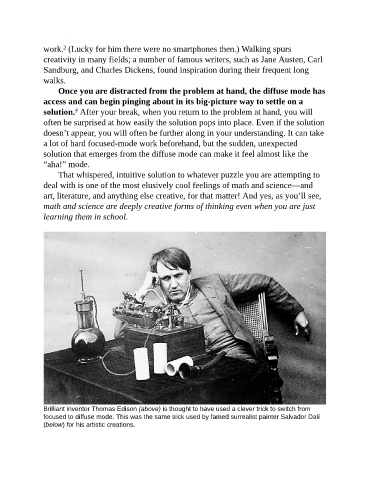
               Brilliant inventor Thomas Edison (above) is thought to have used a clever trick to switch from
               focused to diffuse mode. This was the same trick used by famed surrealist painter Salvador Dalí
               (below) for his artistic creations.

