


Page 38 - A Mind For Numbers: How to Excel at Math and Science
P. 38
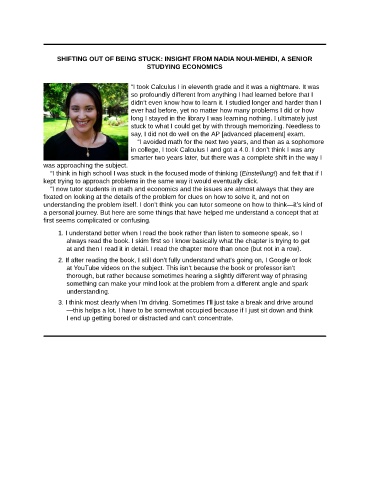
SHIFTING OUT OF BEING STUCK: INSIGHT FROM NADIA NOUI-MEHIDI, A SENIOR
                                                  STUDYING ECONOMICS


                                            “I took Calculus I in eleventh grade and it was a nightmare. It was
                                            so profoundly different from anything I had learned before that I
                                            didn’t even know how to learn it. I studied longer and harder than I
                                            ever had before, yet no matter how many problems I did or how
                                            long I stayed in the library I was learning nothing. I ultimately just
                                            stuck to what I could get by with through memorizing. Needless to
                                            say, I did not do well on the AP [advanced placement] exam.
                                               “I avoided math for the next two years, and then as a sophomore
                                            in college, I took Calculus I and got a 4.0. I don’t think I was any
                                            smarter two years later, but there was a complete shift in the way I
               was approaching the subject.
                  “I think in high school I was stuck in the focused mode of thinking (Einstellung!) and felt that if I
               kept trying to approach problems in the same way it would eventually click.
                  “I now tutor students in math and economics and the issues are almost always that they are
               fixated on looking at the details of the problem for clues on how to solve it, and not on
               understanding the problem itself. I don’t think you can tutor someone on how to think—it’s kind of
               a personal journey. But here are some things that have helped me understand a concept that at
               first seems complicated or confusing.

                    1. I understand better when I read the book rather than listen to someone speak, so I
                       always read the book. I skim first so I know basically what the chapter is trying to get
                       at and then I read it in detail. I read the chapter more than once (but not in a row).
                    2. If after reading the book, I still don’t fully understand what’s going on, I Google or look
                       at YouTube videos on the subject. This isn’t because the book or professor isn’t
                       thorough, but rather because sometimes hearing a slightly different way of phrasing
                       something can make your mind look at the problem from a different angle and spark
                       understanding.
                    3. I think most clearly when I’m driving. Sometimes I’ll just take a break and drive around
                       —this helps a lot. I have to be somewhat occupied because if I just sit down and think
                       I end up getting bored or distracted and can’t concentrate.

