


Page 60 - A Mind For Numbers: How to Excel at Math and Science
P. 60
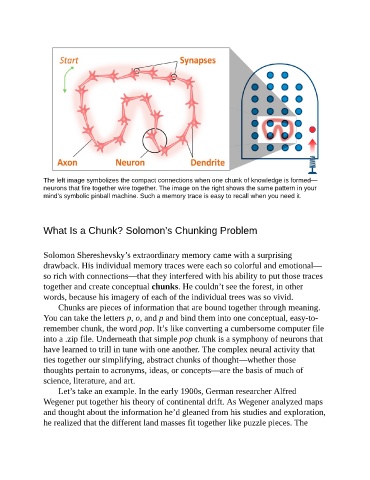
The left image symbolizes the compact connections when one chunk of knowledge is formed—
               neurons that fire together wire together. The image on the right shows the same pattern in your
               mind’s symbolic pinball machine. Such a memory trace is easy to recall when you need it.


               What Is a Chunk? Solomon’s Chunking Problem


               Solomon Shereshevsky’s extraordinary memory came with a surprising
               drawback. His individual memory traces were each so colorful and emotional—
               so rich with connections—that they interfered with his ability to put those traces
               together and create conceptual chunks. He couldn’t see the forest, in other

               words, because his imagery of each of the individual trees was so vivid.
                    Chunks are pieces of information that are bound together through meaning.
               You can take the letters p, o, and p and bind them into one conceptual, easy-to-
               remember chunk, the word pop. It’s like converting a cumbersome computer file
               into a .zip file. Underneath that simple pop chunk is a symphony of neurons that
               have learned to trill in tune with one another. The complex neural activity that

               ties together our simplifying, abstract chunks of thought—whether those
               thoughts pertain to acronyms, ideas, or concepts—are the basis of much of
               science, literature, and art.
                    Let’s take an example. In the early 1900s, German researcher Alfred
               Wegener put together his theory of continental drift. As Wegener analyzed maps
               and thought about the information he’d gleaned from his studies and exploration,
               he realized that the different land masses fit together like puzzle pieces. The

