


Page 62 - A Mind For Numbers: How to Excel at Math and Science
P. 62
the night. Most of the details in the worked-out solution are right there, and your
               task is simply to figure out why the steps are taken the way they are. That can
               help you see the key features and underlying principles of a problem.
                    Some instructors do not like to give students extra worked-out problems or
               old tests, as they think it makes matters too easy. But there is bountiful evidence
               that having these kinds of resources available helps students learn much more
                        5
               deeply.  The one concern about using worked-out examples to form chunks is
               that it can be all too easy to focus too much on why an individual step works and
               not on the connection between steps—that is, on why this particular step is the
               next thing you should do. So keep in mind that I’m not talking about a cookie-
               cutter “just do as you’re told” mindless approach when following a worked-out
               solution. It’s more like using a guide to help you when traveling to a new place.
               Pay attention to what’s going on around you when you’re with the guide, and

               soon you’ll find yourself able to get there on your own. You will even begin to
               figure out new ways of getting there that the guide didn’t show you.


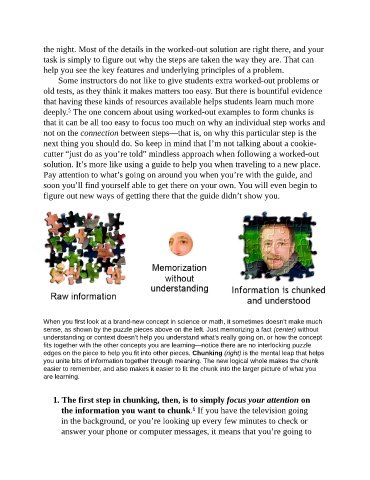
               When you first look at a brand-new concept in science or math, it sometimes doesn’t make much
               sense, as shown by the puzzle pieces above on the left. Just memorizing a fact (center) without
               understanding or context doesn’t help you understand what’s really going on, or how the concept
               fits together with the other concepts you are learning—notice there are no interlocking puzzle
               edges on the piece to help you fit into other pieces. Chunking (right) is the mental leap that helps
               you unite bits of information together through meaning. The new logical whole makes the chunk
               easier to remember, and also makes it easier to fit the chunk into the larger picture of what you
               are learning.


                   1. The first step in chunking, then, is to simply focus your attention on
                                                                 6
                     the information you want to chunk.  If you have the television going
                     in the background, or you’re looking up every few minutes to check or
                     answer your phone or computer messages, it means that you’re going to

