


Page 160 - Physics Form 5 KSSM_Neat
P. 160
3.  Move the copper rod quickly in direction A as shown in Figure 4.16. Observe the deflection of
              the galvanometer pointer.
            4.  Repeat step 3 in directions B, C and D.
            5.  Hold the copper rod with your left hand. Lift up the Magnadur magnet with your right hand.
              Move the Magnadur magnet in direction A and direction B with the copper rod stationary in
              between the poles of the magnet. Observe the deflection of the galvanometer pointer.
            KEMENTERIAN PENDIDIKAN MALAYSIA
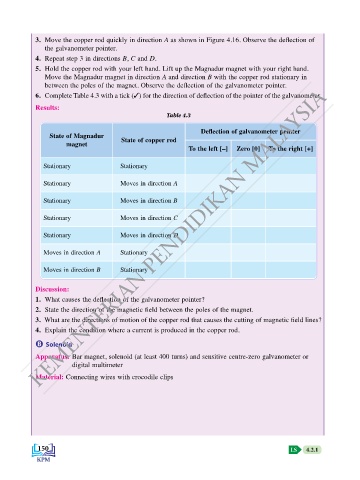
            6.  Complete Table 4.3 with a tick (✓) for the direction of deflection of the pointer of the galvanometer.

            Results:
                                                   Table 4.3

                                                             Deflection of galvanometer pointer
                State of Magnadur
                                     State of copper rod
                     magnet
                                                          To the left [–]   Zero [0]   To the right [+]

              Stationary             Stationary

              Stationary             Moves in direction A

              Stationary             Moves in direction B

              Stationary             Moves in direction C


              Stationary             Moves in direction D

              Moves in direction A   Stationary

              Moves in direction B   Stationary


            Discussion:
            1.  What causes the deflection of the galvanometer pointer?
            2.  State the direction of the magnetic field between the poles of the magnet.
            3.  What are the directions of motion of the copper rod that causes the cutting of magnetic field lines?
            4.  Explain the condition where a current is produced in the copper rod.

            B Solenoid
            Apparatus: Bar magnet, solenoid (at least 400 turns) and sensitive centre-zero galvanometer or
                       digital multimeter
            Material: Connecting wires with crocodile clips


            150                                                                         LS   4.2.1

