


Page 184 - Physics Form 5 KSSM_Neat
P. 184
5.1   Electron

           Thermionic Emission and Cathode Rays                                                                             1
           You have learnt that current, I is the rate of flow of charges in a conductor. An electric current is
           produced when charged particles (electrons) flow in a conductor. Can electrons move through a
           vacuum without a conductor?
            KEMENTERIAN PENDIDIKAN MALAYSIA

              Activity        5.1                                                       ISS   ICS

            Aim: To generate idea on thermionic emission and cathode rays
                                                                                 SCAN ME
                                                                                 SCAN ME
            Instructions:                                                          EduwebTV:
            1.  Carry out this activity in groups.                                 Thermionic
            2.  Scan the QR code to watch the video on thermionic                  emission and
                                                                                   cathode rays
              emission and cathode rays.
                                                                              https://bit.ly/3gJuQII
            3.  Based on the video, discuss the following:
              (a)  What is thermionic emission?
              (b)  What are the functions of the 6 V power supply and the extra high tension (E.H.T)
                  power supply?
              (c)  Why must the tube be in a state of vacuum?
              (d)  How can cathode rays be produced in a vacuum tube?                                                       2
            4.  Present your findings.

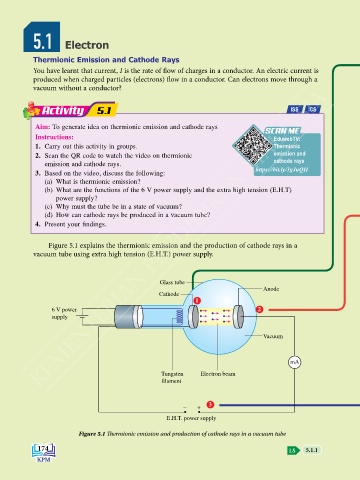
                Figure 5.1 explains the thermionic emission and the production of cathode rays in a
           vacuum tube using extra high tension (E.H.T.) power supply.


                                                                                                                            3
                                                 Glass tube
                                                                                Anode
                                                 Cathode
                                                            1
                 6 V power                                                    2
                 supply


                                                                                Vacuum


                                                                                        mA

                                                 Tungsten    Electron beam
                                                 filament


                                                                3
                                                        –   +
                                                   E.H.T. power supply

                         Figure 5.1 Thermionic emission and production of cathode rays in a vacuum tube
            174                                                                         LS     5.1.1

