


Page 189 - Physics Form 5 KSSM_Neat
P. 189
Velocity of an Electron in a Cathode Ray Tube                                               CHAPTER 5
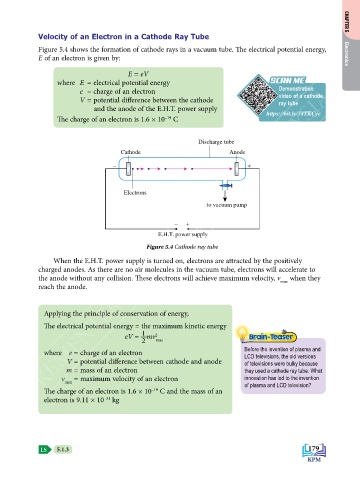
             Figure 5.4 shows the formation of cathode rays in a vacuum tube. The electrical potential energy,
             E of an electron is given by:                                                               Electronics

                                       E = eV
                                                                                  SCAN ME
                  where  E  = electrical potential energy                         SCAN ME
              KEMENTERIAN PENDIDIKAN MALAYSIA
                         e  = charge of an electron                                  Demonstration
                         V = potential difference between the cathode                video of a cathode
                                                                                     ray tube
                             and the anode of the E.H.T. power supply            https://bit.ly/34TKCye
                  The charge of an electron is 1.6 × 10  C
                                                  –19


                                                             Discharge tube
                                     Cathode                          Anode
                                   –                                       +


                                      Electrons
                                                               to vacuum pump


                                                     –   +
                                                E.H.T. power supply

                                             Figure 5.4 Cathode ray tube
                 When the E.H.T. power supply is turned on, electrons are attracted by the positively
             charged anodes. As there are no air molecules in the vacuum tube, electrons will accelerate to
             the anode without any collision. These electrons will achieve maximum velocity, v max  when they
             reach the anode.


              Applying the principle of conservation of energy,
              The electrical potential energy = the maximum kinetic energy
                                            1
                                      eV =  mv  2                           Brain-Teaser
                                            2   max
              where  e = charge of an electron                            Before the invention of plasma and
                                                                          LCD televisions, the old versions
                     V = potential difference between cathode and anode   of televisions were bulky because
                     m = mass of an electron                              they used a cathode ray tube. What
                   v max  = maximum velocity of an electron               innovation has led to the invention
              The charge of an electron is 1.6 × 10  C and the mass of an   of plasma and LCD television?
                                               –19
              electron is 9.11 × 10  kg
                                –31


                                                                                              5.1.3
             LS     5.1.3                                                                     179

