


Page 221 - Physics Form 5 KSSM_Neat
P. 221
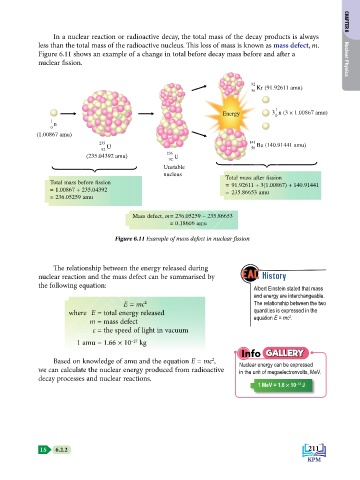
In a nuclear reaction or radioactive decay, the total mass of the decay products is always   CHAPTER 6
             less than the total mass of the radioactive nucleus. This loss of mass is known as mass defect, m.
             Figure 6.11 shows an example of a change in total before decay mass before and after a
             nuclear fission.                                                                            Nuclear Physics


                                                                            92
              KEMENTERIAN PENDIDIKAN MALAYSIA
                                                                              Kr (91.92611 amu)
                                                                            36
                                                                                    1
                                                                    Energy         3 n (3 × 1.00867 amu)
                                                                                    0
                1
                 n
                0
            (1.00867 amu)
                               235                                          141  Ba (140.91441 amu)
                                 U                                          56
                               92
                                                   236
                           (235.04392 amu)           U
                                                    92
                                                  Unstable
                                                  nucleus
                                                                     Total mass after fission
                Total mass before fission
                                                                     =  91.92611 + 3(1.00867) + 140.91441
                = 1.00867 + 235.04392
                                                                     =  235.86653 amu
                = 236.05259 amu
                                         Mass defect, m = 236.05259 – 235.86653
                                                    = 0.18606 amu
                                    Figure 6.11 Example of mass defect in nuclear fission


                 The relationship between the energy released during
             nuclear reaction and the mass defect can be summarised by          History
             the following equation:                                         Albert Einstein stated that mass
                                                                             and energy are interchangeable.
                                      E = mc 2                               The relationship between the two
                      where  E = total energy released                       quantities is expressed in the
                                                                                        2
                            m = mass defect                                  equation E = mc .
                             c = the speed of light in vacuum
                        1 amu = 1.66 × 10  kg
                                        –27
                                                                          Info GALLERY
                 Based on knowledge of amu and the equation E = mc ,     Nuclear energy can be expressed
                                                                 2
             we can calculate the nuclear energy produced from radioactive   in the unit of megaelectronvolts, MeV.
             decay processes and nuclear reactions.
                                                                              1 MeV = 1.6 µ 10  J
                                                                                          –13


             LS   6.2.2                                                                       211

